

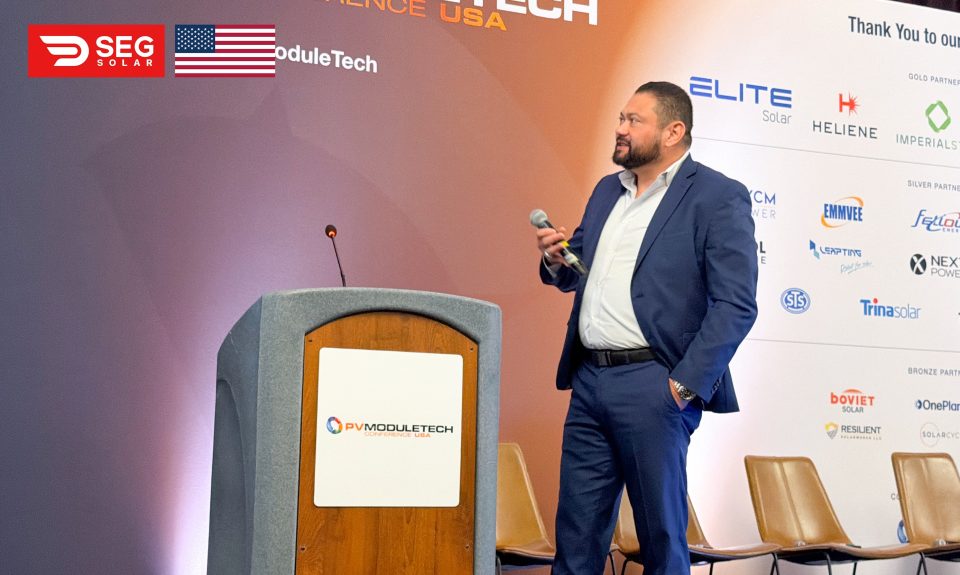
The global solar market remains constrained by persistent overcapacity, even as the technology race is already shaping tomorrow’s leaders: TOPCon 3.0 is emerging as the short‑term standard, while trade tensions and price pressure are forcing manufacturers to rethink strategy.
Surplus capacity and commercial outlook
Overcapacity is the main obstacle to a broad recovery in the photovoltaic market. According to Alex Barrows, head of PV at the analyst firm cited at SNEC & Intersolar 2026, M&A activity has delayed the retirement of significant capacity, perpetuating excess supply. For example, polysilicon capacity in China is estimated to be roughly three times market demand — a mismatch that is depressing margins and prolonging the sector’s downcycle.
Barrows notes that some segments, such as European residential, are showing signs of recovery, but the slowdown planned under China’s 15th Five‑Year Plan calls medium‑term growth projections into question and complicates ambitions to reach terawatt‑scale annual installations by 2030. Markets in Africa, the Middle East and parts of Asia, however, still present upside opportunities.
Why TOPCon 3.0 will dominate
On the technology front, TOPCon 3.0 is identified as the dominant short‑term solution. Evolutionary changes — poly‑finger architectures, improved edge passivation, multi‑cut cells and overlapping layouts — collectively deliver efficiency gains while remaining compatible with existing value chains. Barrows is more cautious about the breakthrough of Bach (BC), whose cost parity with TOPCon is not expected until between 2028 and 2030, leaving a window of coexistence for both technologies. Perovskite‑silicon tandems are not expected to have significant commercial impact until the early 2030s.
Price pressure, costs and product quality
Prices rebounded in H1 2026 due to increases in aluminum, silver and encapsulants, driven in part by geopolitical disruptions. China’s removal of export VAT rebates also contributed to the price uptick. Nevertheless, competition remains fierce: some players expect profitability to recover in H2 2026, while others are still accepting losses.
Margin compression is weighing on quality. Real‑world testing has revealed reliability issues, notably delamination and encapsulation defects. Many buyers are unwilling to pay a premium for higher‑quality modules, creating a dilemma for manufacturers between price competitiveness and product durability.
International trade and litigation risks
Trade remains active but fraught with friction. Chinese exports of cells and modules rose 12% year‑on‑year over the first five months of 2026, but forecasts call for about a 5% decline for the full year, largely because of India’s cell‑level ALMM requirements. Meanwhile, cell manufacturing capacity is emerging in Africa — in Nigeria, Kenya and Ethiopia — and Philippine cell exports to the United States are increasing. These developments could attract anti‑dumping and countervailing investigations, particularly if those plants use Chinese wafers that might trigger anti‑circumvention measures.
Manufacturer diversification
Facing prolonged pressure in the core PV market, many players are pivoting to adjacent segments. Energy storage is the primary target for diversification, and some companies are also investing in power electronics. These pivots help dilute the cyclical risk of the solar sector, but they do not erase the structural impact of overcapacity on prices and profitability.
Looking ahead
The market correction driven by excess supply will persist in the near term, even as TOPCon 3.0 establishes itself as the pragmatic technological leader. Commercial success over the next several years will hinge on manufacturers’ ability to balance cost, quality and strategic diversification amid an increasingly complex trade landscape.
