

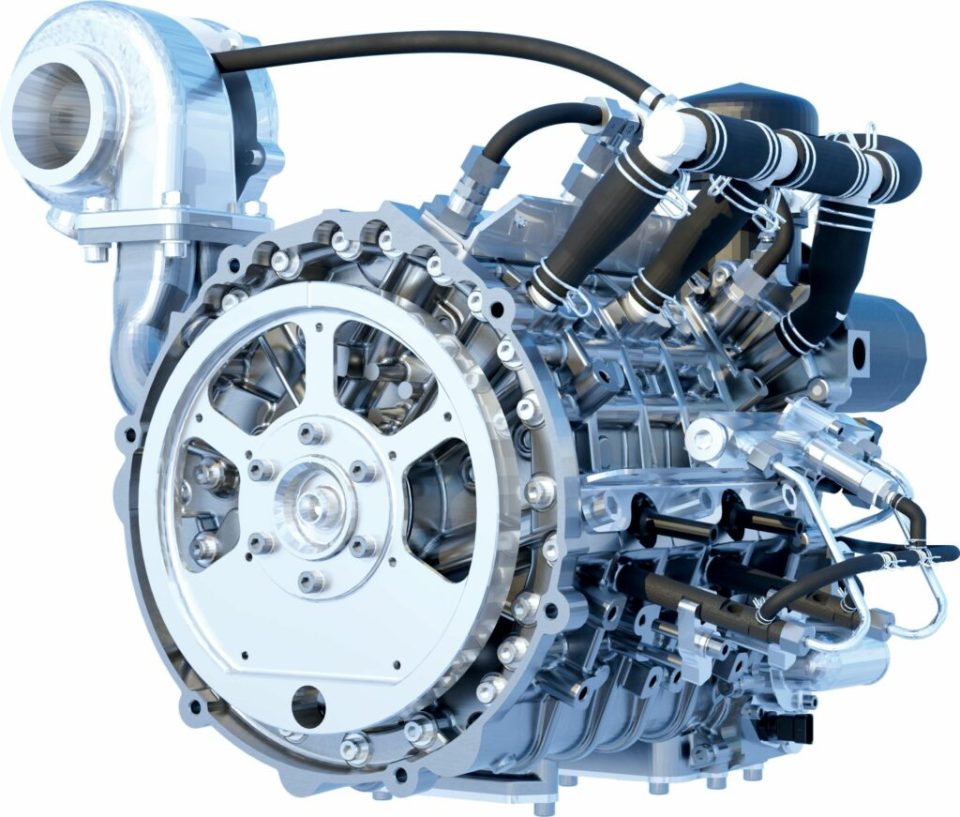
A project for a valveless rotary internal combustion engine without a valve train system, which is seeking seed‑round financing, filed an invention patent application (Patent Application No.: 2026109550368) with the National Intellectual Property Administration on June 30, 2026; the application has now entered the substantive examination stage.
Internal combustion engines are currently divided into three main categories: reciprocating engines, rotary engines and gas turbine engines. The source document summarizes common trade‑offs: reciprocating engines offer good sealing, reliable operation and long service life but suffer from complex structures, large vibration and noise, lower effective power and speed, large size and weight, and higher production costs—with the valve train notably limiting power and rotational speed. Rotary engines, such as the Wankel design, deliver compactness, light weight, high rpm and low vibration, but are described as having more complex structures, poorer sealing, incomplete combustion, higher emissions and fuel consumption, weaker low‑speed performance and higher cost. Gas turbine engines are noted for direct rotary output, light weight and high‑speed performance but are said to be costly, noisy, fuel‑hungry and unsuitable for lower‑speed applications such as cars or ships.
Valveless rotary internal combustion engine: claimed design and advantages
The project proposes a rotary internal combustion engine that omits a valve train and aims to combine the stated strengths of reciprocating and rotary engines while overcoming their listed disadvantages. According to the source, the design is intended to raise effective power and rotational speed, reduce vibration, noise and fuel consumption, simplify structure, and significantly lower weight, volume and manufacturing cost.
The document lists specific performance claims and advantages:
First, power can be increased without adding cylinders by increasing the number of working cycles (adding air inlets and exhaust ports); if additional working cycles are not possible, power may be increased by adding cylinders. The source claims equivalences in power output: a 2‑cylinder 2‑working‑cycle engine equals an existing 4‑cylinder engine; a 2‑cylinder 4‑working‑cycle engine equals an existing 8‑cylinder engine; a 4‑cylinder 2‑working‑cycle engine equals an existing 8‑cylinder engine; and a 4‑cylinder 4‑working‑cycle engine equals an existing 16‑cylinder engine.
Second, the project claims small size and light weight, with volume and weight reduced by about 50% to 80% compared with traditional reciprocating engines, based on the stated power equivalences.
Third, production cost is claimed to be only 20% to 50% of the production cost of existing reciprocating engines, attributed to the reduced volume and weight.
Fourth, multiple engines can be connected in series to manufacture higher‑power units, which the source says saves time, manufacturing cost and maintenance cost.
Fifth, a clutch is proposed to control power connection between two engines: the connection can be disengaged in congested traffic so that only one engine runs, and engaged on open roads for full power, with the stated goal of improving fuel efficiency and reducing operating cost.
Sixth, the design permits one engine to independently drive one wheel, which the document says enables four‑wheel drive, on‑site U‑turns and sideways parking.
Seventh, because of its small size, light weight, high thrust‑to‑weight ratio and low manufacturing cost, the project positions the engine as a suitable power source for aerospace vehicles—specifically as an optimal option for multi‑rotor aircraft—and as a core technology for the low‑altitude economy.
Eighth, the source claims the engine can be combined with rocket engines to produce reusable aerospace vehicles or aerospace vehicle launch platforms.
The document states the project can provide power across transportation, aerospace, industry, agriculture and national defense, describes a very large market scale, and repeats the production cost claim of 20% to 50% of current internal combustion engine costs. It also frames the project as highly consistent with national policies to develop the low‑altitude economy and as a potential booster for that sector.
The application number and filing date are provided as technical facts: Patent Application No.: 2026109550368, filed June 30, 2026, now in substantive examination.
