

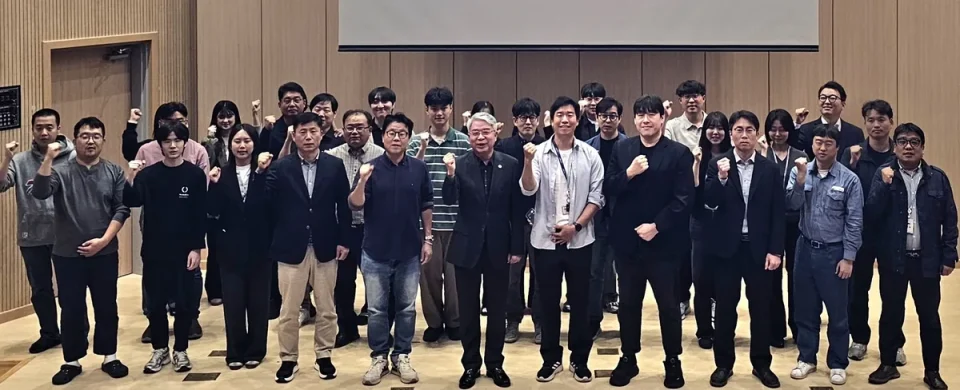
ULSAN — Technologies for training artificial intelligence without moving sensitive manufacturing data outside companies, and methods for using process time-series data, were presented to Ulsan’s industrial community at a seminar on the 15th. The aim was to offer practical solutions for local factories that face data security concerns and limited in-house AI capability.
About 50 people attended the “2nd Plenary Meeting and Industrial AX (AI Transformation) Technology Trends Seminar,” organized by the Ulsan Information Industry Promotion Agency and the Digital Innovation U Forum at the agency’s main auditorium. Attendees included Lee Dong-gu, chair of the Digital Innovation U Forum and an honorary researcher at the Korea Research Institute of Chemical Technology and visiting professor at the University of Ulsan, subcommittee members, local company officials and outside experts. The seminar was open to local business owners as well as forum members.
The program focused on data security at manufacturing sites and technologies to make production processes smarter. Yoo Jae-joon, a professor at the Graduate School of Artificial Intelligence at the Ulsan National Institute of Science and Technology (UNIST), presented trends and applications for training AI without exporting manufacturing data. Noting that security concerns make it difficult for manufacturers to pool data centrally, Yoo outlined the principles of federated learning, which keep original data inside each company and share only training results, and he proposed ways to apply the approach across Ulsan’s manufacturing supply chain.
Factory AI approaches: federated learning and time-series models
Sung Min-seok, chief operating officer of OnePredict, spoke on trends and applications in time-series data technology (Time-LLM) for the manufacturing industry. Sung described a technological shift from Time-LLM to time-series foundation models (TSFM) and introduced a strategy for an “AI native factory,” in which AI is first applied to small-scale processes before being extended across an entire plant. A question-and-answer session followed, during which participants discussed considerations for on-site deployment of the technologies.
The Ulsan Information Industry Promotion Agency reorganized the Digital Innovation U Forum in 2024 into six subcommittees with 87 members to identify digital innovation policy tasks for the region’s key industries.
“Ulsan’s manufacturing sites have accumulated vast amounts of data, but in many cases it could not be put to immediate use in the AI transition because of security issues and insufficient capability,” Lee said. An official at the Ulsan Information Industry Promotion Agency added, “The success or failure of manufacturing AX depends on using on-site data safely and effectively,” and said, “We will provide support so that the technologies discussed at the seminar lead to actual AI adoption at local companies.”
