

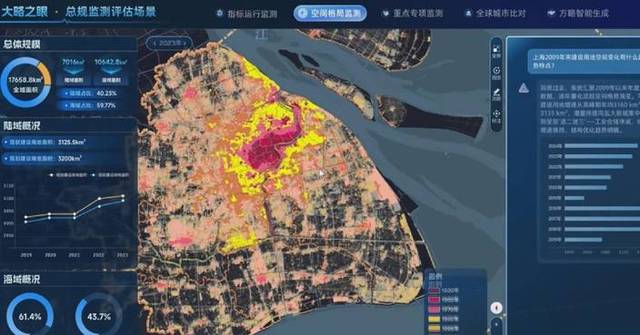
Shanghai unveiled the first wave of six quantum-enhanced government AI agents for urban management at the Quantum City Spatial Intelligence Forum, held alongside the World AI Conference (WAIC) 2026 and the High-Level Meeting on Global AI Governance. The tools—designed to strengthen urban governance and public services—were revealed after a two-day forum that concluded Saturday.
A digital-twin anti‑flood agent
The headline project is a still-under-debugging anti‑flood agent that relies on a high‑precision digital twin covering 21 kilometers of the central Suzhou River. Using advanced computational models, the agent produces graded rainfall forecasts spanning two to 48 hours to support operational flood-control decisions. “We modelled surface ‘sponge’ facilities, underground municipal drainage networks and roadside sump pits. This high‑precision foundation is essential if the model is to be relied on for real‑world flood management decisions,” said Zhou Xiang, project lead for the anti‑flood agent.
Bringing public services closer to residents
One of the six agents aggregates six major categories and 21 high‑frequency public services, aimed at simplifying daily life for residents. It helps users quickly locate specific facilities—such as rooms for breastfeeding or community canteens—and covers services related to clothing, food, housing and transportation. “Residents can rapidly find the facilities they need—for example which sites offer child rooms or which community centers have canteens,” said Huang Yao, the project manager.
Agents for planning, rural monitoring and enforcement
The remaining four agents focus on rural areas, urban strategy, plan approval, and the enforcement of planning resources. Their stated goals are to improve large‑scale urban governance, protect rural landscapes, and boost the efficiency of planning enforcement. Project teams say these tools use large AI models to process spatial and operational data in support of administrative decision‑making.
A measured path to operational use
Dubbed the “first wave,” these quantum‑enhanced government AI agents will undergo further field testing and calibration to ensure the reliability of models and forecasts in operational settings. Officials stressed the need for highly accurate digital twins and the integration of existing physical infrastructure so that the agents can serve as trusted decision‑support tools during critical events like intense rainstorms.
A new phase for smart-city experimentation
By deploying these tools within a “Quantum City” framework, Shanghai is opening a new phase of experimenting with AI systems for city management and public services—while keeping operational validation front and center for sensitive applications such as flood control.
