

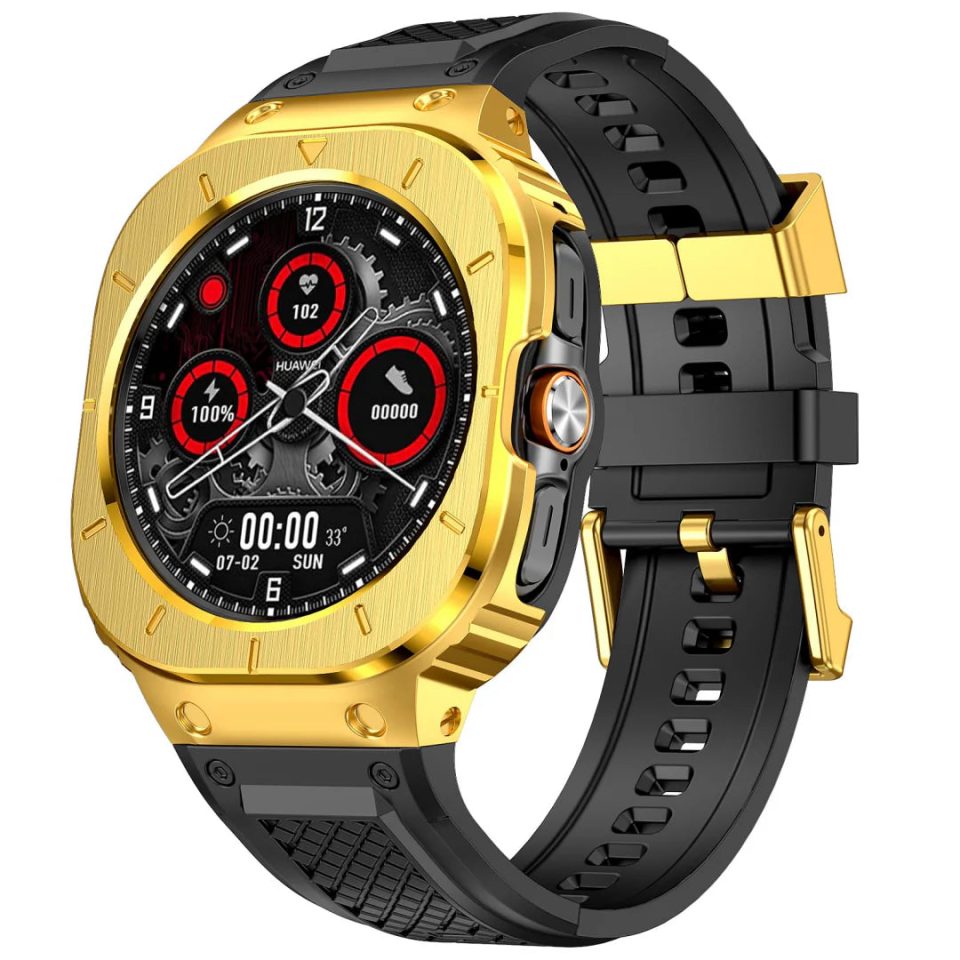
Samsung officially unveiled the Galaxy Watch 9 on July 22 during the second Galaxy Unpacked event of the year. The company highlights improved performance, better battery life, and more proactive health features while retaining the design language introduced last year.
Galaxy Watch 9: design, sizes and comfort
The Watch 9 keeps the squared silhouette first seen with the 2025 model and is available in two sizes — 40 mm (1.34-inch display) and 44 mm (1.47-inch display) — with resolutions of 438 x 438 and 480 x 480 pixels respectively, and peak brightness rated up to 3,000 nits. The lightweight aluminum case is topped with sapphire glass and carries MIL-STD-810H, IP68 and 5 ATM durability ratings. Dimensions and weights are 42.7 x 40.4 x 8.6 mm at 31.5 g for the 40 mm, and 46.0 x 43.7 x 8.6 mm at 34 g for the 44 mm. Samsung also emphasizes comfort: the watch is 17% lighter and ships with a new “Sports” strap featuring an air-pocket structure, plus Misty two-tone silicone and Fabric strap options.
Performance and revamped connectivity
Under the hood, Samsung replaces the Exynos W1000 with a Snapdragon Wear Elite (SDW6100, 3 nm) five-core processor, claiming CPU gains of 32% and GPU gains of 19% versus the previous SoC. Memory is 2 GB of RAM with 32 GB of storage. Connectivity is upgraded to Bluetooth 6.0 and Wi‑Fi 6 (2.4 + 5 GHz), with LTE available as an option; the watch also includes NFC and dual-frequency GPS (L1 + L5).
Display, battery and software
Both sizes retain Super AMOLED panels with very high brightness. Battery capacities increase to 390 mAh for the 40 mm model (up from 325 mAh) and 445 mAh for the 44 mm model (up from 435 mAh). The Galaxy Watch 9 runs One UI 9 Watch based on Wear OS 7, and Samsung promises five major system updates.
Health, proactive monitoring and included services
Samsung is positioning the Galaxy Watch 9 as a proactive care device: it leverages the BioActive sensor alongside temperature, accelerometer, barometer, gyroscope, geomagnetic and ambient light sensors to turn vitals into actionable insights. The approach is built on five pillars: baseline vitals monitoring with alerts for significant deviations; a cardiac health score with personalized recommendations; daily cardio load to optimize training; an overall fitness index; and hearing monitoring (alerts and reports to help protect long-term hearing). Samsung also includes trial subscriptions at purchase: 60 days of Strava and two months of iFIT.
Availability, pricing and preorder window
Preorders opened on July 22 and run through August 7, which is also the watch’s general availability date.
