

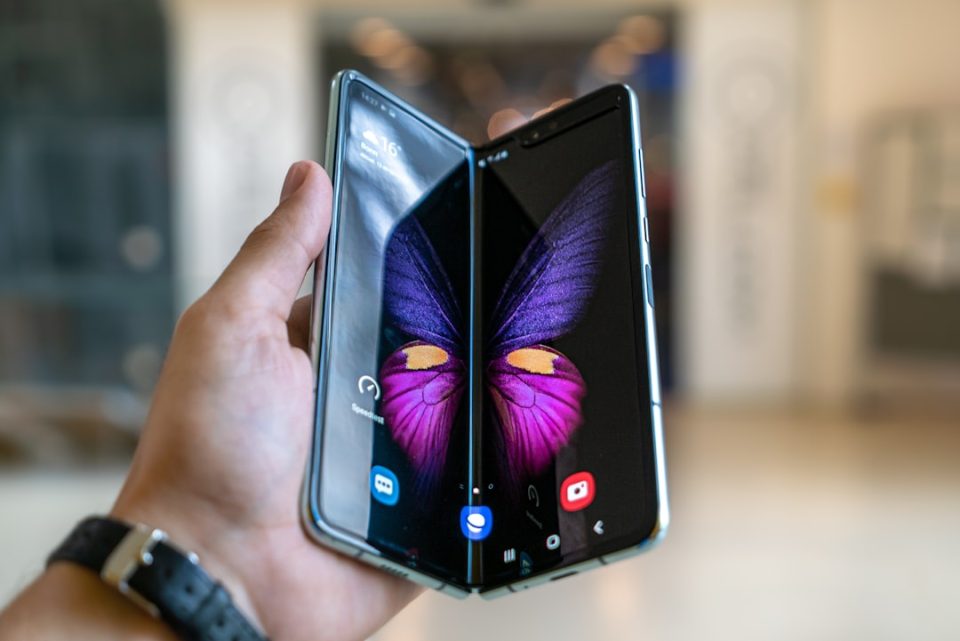
Samsung’s Galaxy Z Fold 8 Ultra is a focused evolution of its foldable format, concentrating on thinness, battery life, display quality and durability. Individually some changes are modest on paper, but together they make the Fold experience noticeably smoother and more reliable than the Galaxy Z Fold 7.
Galaxy Z Fold 8 Ultra: a cleaner, brighter foldable display
The Fold 8 Ultra debuts Samsung’s Flex Titanium Display, which adds an ultra-thin titanium-alloy film under the OLED panel plus a flexible titanium support plate. Samsung says the film is roughly one third the thickness of a human hair while delivering three times the mechanical rigidity of the previous polymer film. The visible result is a much less pronounced crease—almost imperceptible in certain usage scenarios—and improved touch stability when opening the device.
The inner panel keeps the same physical dimensions but gains resolution, rising from 1,968 × 2,184 to 2,256 × 2,504 pixels, and increases density from 368 ppi to 422 ppi for a sharper image. Peak brightness also climbs from 2,600 nits to 3,000 nits, improving outdoor readability. Samsung adds an anti‑reflective coating that cuts reflections by up to 50%, boosting perceived brightness in challenging lighting.
A thinner profile and a bigger battery
The Galaxy Z Fold 8 Ultra remains compact when folded (8.9 mm) and gets slightly slimmer when open: 4.1 mm versus 4.2 mm on the previous model. That 0.1 mm reduction is subtle on paper but yields a more refined in‑hand feel.
At the same time, Samsung significantly increased battery capacity from 4,400 mAh to 5,000 mAh—the largest battery ever fitted into a Fold. This gain is enabled by a higher energy‑density silicon‑carbon battery chemistry, which improves autonomy without thickening the chassis. Efficiency is further aided by the anti‑reflective display and a more power‑efficient SoC.
Charging speeds are also stepped up: the Fold 8 Ultra supports 45 W wired and 20 W wireless charging, compared with 25 W wired and 15 W wireless on the previous generation.
Performance: an SoC tuned for the Ultra use case
The phone ships with the Qualcomm Snapdragon 8 Elite Gen 5 for Galaxy. Qualcomm’s figures show measurable gains: up to 20% higher CPU performance with 35% better energy efficiency, up to 23% GPU performance improvement with 20% higher efficiency, and up to 37% on the NPU with 16% better performance per watt. Overall, the chipset is claimed to deliver roughly 16% better energy efficiency. In practice, expect faster app launches, smoother multitasking and improved AI processing without sacrificing battery life.
Improved durability and protection
Exterior screen protection is incrementally improved: Samsung replaces Corning Gorilla Glass Ceramic 2 with Gorilla Glass Ceramic 3. According to Corning, Ceramic 3 withstands drops exceeding 2 meters onto a concrete‑like surface in test conditions versus about 1 meter for Ceramic 2—effectively doubling drop resistance under those tests. That translates to a lower risk of cracking during everyday use.
Photo: a higher‑resolution ultra‑wide
The ultra‑wide camera jumps from a 12 MP sensor to a larger 50 MP module, capturing more light and detail. On paper this should yield noticeably sharper images and better low‑light performance for wide shots, addressing a known weak point of the prior sensor.
Bottom line
The Galaxy Z Fold 8 Ultra brings a string of targeted upgrades—a cleaner, brighter inner display with a far less visible crease, a slimmer open profile, a larger 5,000 mAh battery enabled by new cell chemistry, faster charging, a more efficient Snapdragon 8 Elite Gen 5 for Galaxy, stronger drop protection and a higher‑resolution ultra‑wide camera—that together deliver a smoother, more reliable Fold experience compared with the Z Fold 7.
