

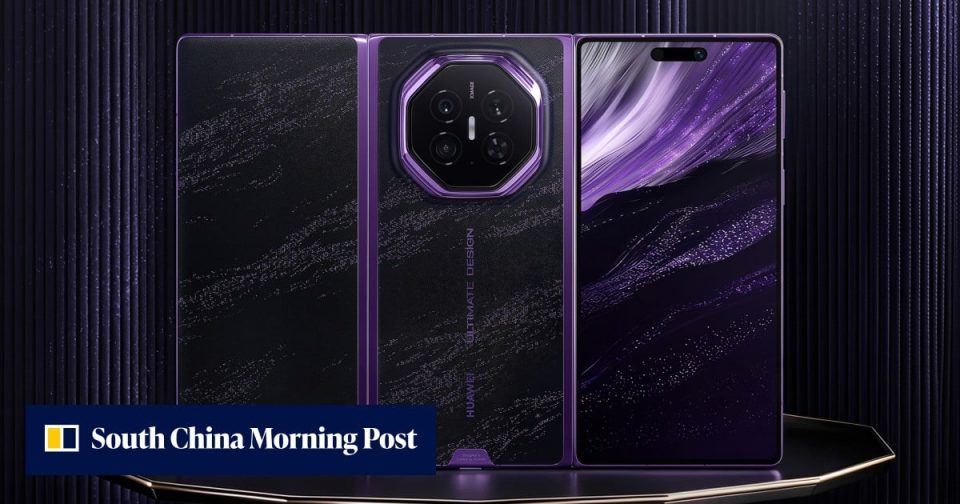
Huawei unveiled its first smartphone using a next-generation mobile processor on Monday, introducing the Mate XT 2 trifold phone powered by the Kirin 9050 Pro, a chip built on the company’s newly established Tau Scaling Law. The device, revealed at a launch event in Guangzhou, starts at 19,999 yuan (US$2,980).
Richard Yu Chengdong, chairman of Huawei’s consumer business group, described the Kirin 9050 Pro as the company’s “most powerful Kirin chip ever”. The announcement continues Huawei’s push to boost chip performance while reducing reliance on advanced foreign semiconductor equipment.
Kirin 9050 Pro and Tau Scaling Law
The Kirin 9050 Pro is based on Huawei’s Tau Scaling Law, an approach that seeks to improve semiconductor performance by reducing signal delays. One technology developed under this approach, LogicFolding, is designed to shorten signal paths and ultimately allow more transistors to be packed into a smaller space.
Huawei said the chip improved overall performance by 42 per cent compared with the previous-generation Mate XTs model released last year. The Kirin 9050 Pro is the processor used in the new Mate XT 2.
Competition in the foldable phone segment is intensifying. Chinese rival Xiaomi was set to announce a new foldable model later on Monday, while Apple’s first-ever foldable was expected to be revealed on Wednesday. Global shipments of foldable phones grew 18 per cent last year, according to Counterpoint Research on Monday, which projected growth to accelerate to 24 per cent this year and 37 per cent in 2027.
HarmonyOS 7 rollout
The Mate XT 2 is also the first device to run HarmonyOS 7, the latest version of Huawei’s self-developed operating system. HarmonyOS 7 was initially released to developers in June as a beta version featuring AI coding agents, and the software began rolling out to existing Huawei phones on Monday.
