

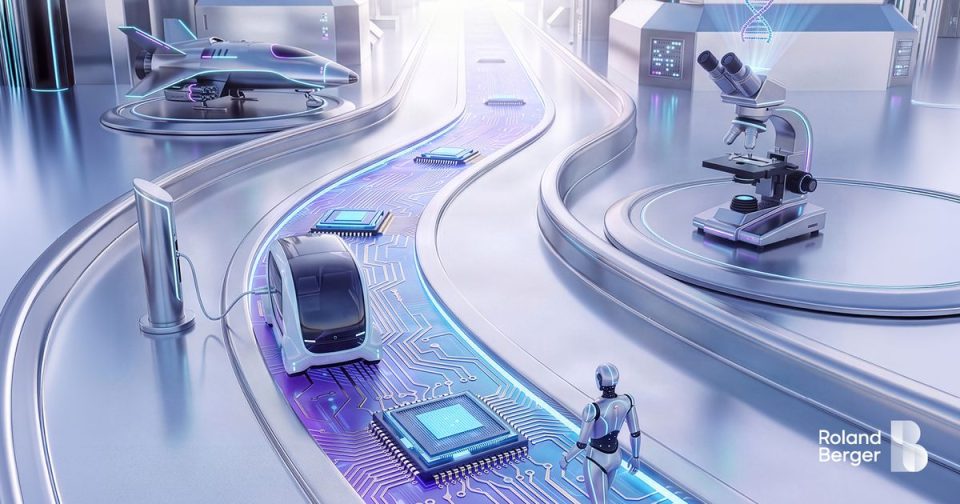
Thirty emerging technology fields are set to drive the next major wave of global economic growth, with their combined market value expected to rise nearly tenfold to more than EUR 20 trillion by 2040 and Europe able to capture around 20% of that potential if industry and policymakers make the right strategic choices.
Munich, September 2026 — A new Roland Berger study, “The 2040 Technology Gameplan,” identifies 30 technology trends—from AI systems and data centers to semiconductors, energy storage, quantum technologies and humanoid robotics—that will shape global industrial value creation over the next 15 years. The study projects these technologies’ share of global industrial value creation to increase from roughly 9% today to 37% by 2040, representing more than one-third of global industrial output.
Future technologies and their market concentration
Fourteen of the 30 trends were singled out as particularly relevant for industry; together they have an estimated combined market potential of around EUR 16 trillion by 2040. Semiconductors, AI systems and data centers alone are expected to account for more than half of that EUR 16 trillion total.
Europe’s position: strengths and structural barriers
The study notes that despite Europe’s world-class research capabilities and strong industrial base, the region has lost ground to the United States and China over recent decades. It attributes this decline mainly to insufficient scaling, limited access to growth capital and institutional complexity. At the same time, Europe remains well positioned in several future-oriented fields—such as quantum technologies and MedTech—where global leadership remains achievable if financing and commercialization gaps are closed.
“Europe faces a clear mandate for action. Policymakers and industry leaders must work together to create the right conditions for investment and scaling. Otherwise, the value creation generated by the next wave of technology trends will take place elsewhere,” says Felix Mogge, Partner at Roland Berger.
According to the analysis, Europe could capture around 20% of the global industrial market potential represented by the 14 most important technology trends by 2040, equivalent to approximately EUR 3 trillion in value creation.
Three strategic pathways for Europe
The study sets out three strategic approaches for European industry and policymakers:
– Global Leadership: For fields where Europe already has strong research and engineering capabilities—examples cited include microgrids, quantum technologies, MedTech and carbon capture—a strategy focused on global market leadership is realistic if gaps in financing and commercialization are addressed.
– European Markets: Not every technology requires global leadership. In areas such as autonomous defense, humanoid robotics and charging infrastructure, Europe’s strong domestic demand, security requirements and targeted support measures can generate substantial market opportunities within Europe alone.
– Localization of Foreign Players: In other areas, including large language models and next-generation semiconductors, the study suggests the gap to global leaders may be too wide to close; attracting international technology providers to establish local operations is presented as the pragmatic route to secure access to critical technologies.
“Europe has the technologies and the talent to compete for global leadership in a number of fields. The challenge now is to choose the right strategy for each technology area and secure Europe’s long-term competitiveness,” says Stefan Riederle, Partner at Roland Berger.
Policy and industry actions called for
The study observes that while China and the United States actively promote and support key future technologies, Europe still lacks a clear industrial strategy in many of these fields. Existing initiatives such as the AI Act, the EU Battery Regulation and the European Chips Act have so far fallen short of their ambitions, the report says, and calls for EU-wide initiatives that enable scale, encourage greater risk-taking and provide long-term certainty for emerging markets. It also urges industry to place larger bets on future technologies, accelerate commercialization and prioritize competitiveness and scaling over technical perfection alone.
About the study
“The 2040 Technology Gameplan” draws on the Roland Berger Advanced Technology Center database, which contains more than 400 regularly assessed technology trends. Using AI-supported clustering methods and expert interviews, the dataset was narrowed to 30 key trends expected to shape the coming decades. Technologies were assessed according to three criteria—disruption potential, expected market size by 2040 and commercialization timeline—and 14 priority technologies were subsequently identified as particularly relevant for industrial companies and policymakers.
