

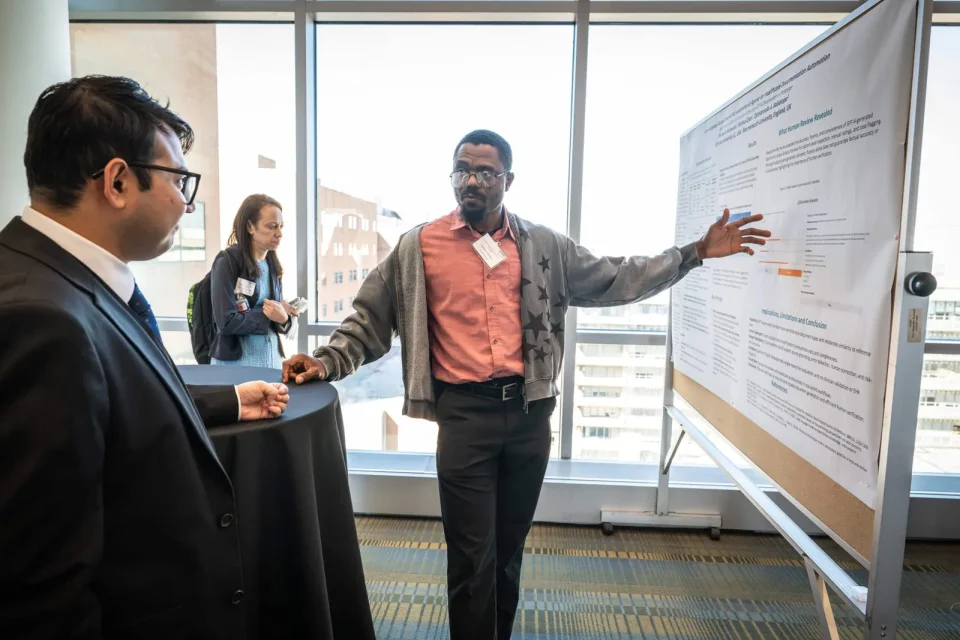
More than 150 people attended the third annual AI conference at the University of Arkansas for Medical Sciences (UAMS), held Oct. 8–9 on the 10th floor of the UAMS Winthrop P. Rockefeller Cancer Institute. Attendance was evenly split between in-person and virtual participants. The event was sponsored by the UAMS Department of Academic Affairs, all UAMS colleges and the graduate school, and numerous community partners.
AI governance and safeguards at UAMS
The conference emphasized ethical and responsible use of artificial intelligence across UAMS’s missions of research, education and clinical care. Wendy Ward, Ph.D., professor in the UAMS College of Medicine and associate provost for academic affairs, said the meeting aims to “translate emerging possibilities into safe, effective, and responsible applications that drive scientific discovery, enrich the education of our next‑generation workforce, and improve access to high‑quality care.”
UAMS has established institutional safeguards, including an AI Governance Committee within the Office of Academic Affairs that oversees governance, approval, monitoring and lifecycle management of AI tools. The committee includes subgroups that evaluate academic, research and administrative applications; Fred Prior, Ph.D., distinguished professor and chair of the UAMS Department of Biomedical Informatics, is a member.
Prior warned about pitfalls as innovation outpaces regulation. He noted that the National Institutes of Health had to change rules on R01 grant submissions after some researchers submitted more applications than “a human could write without AI doing the writing.” Prior also raised concerns about medical AI transcription devices, or scribes: only 25% of such devices have privacy or risk policies in place, he said, and of the 1,357 AI medical devices cleared by the Food and Drug Administration in the past year, only three had any data on whether they positively affected patient outcomes. “Without that validation that the tools that we’re buying are effective, what are we paying our money for?” Prior said. “Responsible use comes down to us making good decisions about, is this tool really going to help, and how do I know it’s going to help? Even if it works correctly today, is it still going to work correctly a year from now?” He added a cautionary image of AI‑generated lemmings and said, “Nobody wants to be left behind.”
Adoption, risks and clinical use
Joseph Sanford, M.D., chief clinical informatics officer for UAMS, said the health system now uses 57 AI tools across multiple functions. He described AI as a way to streamline technical, time‑consuming reporting and recordkeeping tasks. Sanford said the efficiency of AI scribes is increasing clinic capacity: use of scribes for patient notation in Arkansas rose from 6.8% of patients last year to over 12% this year. He recounted a recent six‑hour outage of an AI scribe program that prompted a clinician to ask, “How do you expect me to see clinic?” — illustrating how quickly some providers have come to rely on the technology.
Sanford stressed that AI models can fail like any tool and that there must always be “a human in the loop.” “We have to do this responsibly, which means setting a pathway,” he said.
Prior, Sanford and Jonathan Bona, Ph.D., associate professor of bioinformatics, answered audience questions in an informal panel during the first day. Scott Wright, Ed.D., and Josiah Wheeler, M.Ed., assistant professors of institutional design, led an interactive session with workbook exercises on AI use in health professions assessments.
Research, education and national perspectives
The conference’s second day featured remarks from Stephanie Gardner, Pharm.D., Ed.D., provost and chief strategy officer for UAMS, who said AI should enhance, not replace, the human connection to medicine. Presentations included a deep dive on AI data methodology by Mathias Brochhausen, Ph.D.; pediatric patient risk models from Branson Bolden, M.D., Larry Smith, BSN, and Obeid Shafi, M.D.; and a fall risk assessment model from Jonathan Bona. Poster sessions displayed additional findings from researchers in Arkansas and across the country.
Two national speakers addressed broader implications. Vaile Wright, Ph.D., senior director for health care innovation at the American Psychological Association, highlighted a gap in mental healthcare driven by cost, access and provider shortages. She said patients have turned to AI for psychological support even though it is not a replacement for treatment, and she urged improved AI literacy, governance and human oversight.
Sean Mooney, Ph.D., director of the NIH’s Center for Information Technology, described AI’s rapid movement over the past two years as a “state of disequilibrium.” Drawing an analogy to meteorology, he argued that medicine could learn from decades of development in predictive weather modeling and move toward shared, interoperable platforms. Mooney said the NIH funded more than $400 million in AI programs in 2025, with investment growing 43% on average each year, and that AI already assists with phone surveys and connecting patients to clinical trials.
The conference closed with a panel moderated by Ward that included Prior, Sanford, Kathryn Neill, Pharm.D., associate provost for academic affairs, and Brandon Robinson, J.D., MHA, managing associate general counsel and chief legal counsel for UAMS Health. Panelists agreed it was difficult to predict where AI will be in five years and emphasized maintaining a human element. When asked which skills people should develop to adapt to AI growth, Sanford said curiosity; Neill said humility; and Prior said critical thinking.
Attendee Amy Widner, director of recruiting for the UAMS College of Medicine, said she found it inspiring to hear how campus colleagues are incorporating AI into research, clinical care, education and administration and appreciated having a forum to discuss a shared, ethical vision for the future.
