

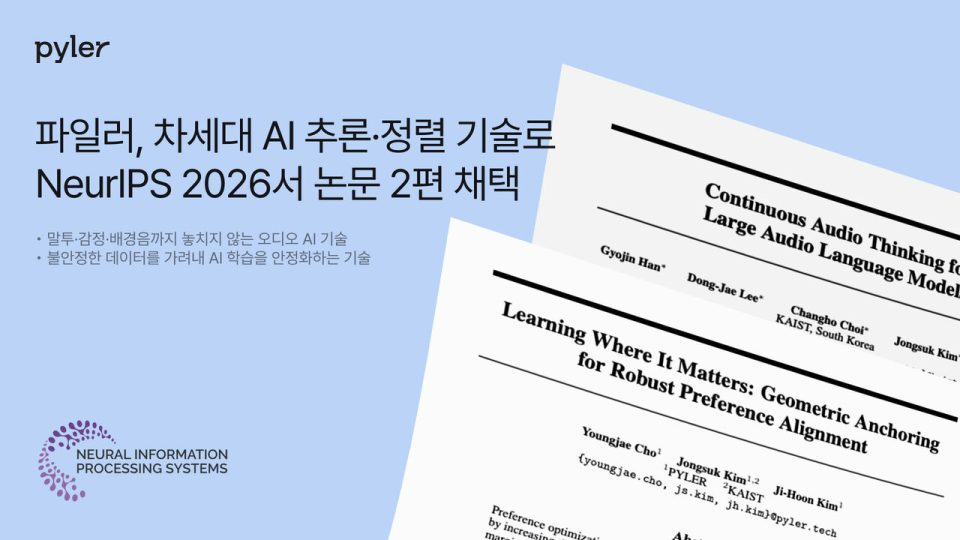
Video-understanding AI company Filer said on Oct. 21 that two of its research papers were accepted to the Conference on Neural Information Processing Systems (NeurIPS) 2026 and will be presented on Dec. 10 in Sydney, Australia.
Filer’s CoAT captures nonverbal speech cues lost in transcription
One accepted paper, Continuous Audio Thought (CoAT), enables AI to incorporate nonverbal information in speech—such as emotion, intonation and pitch—directly into the inference process rather than relying solely on text transcriptions. Filer reported that when CoAT was applied to three voice AI models, 38 of 42 performance evaluation metrics improved. In a highlighted result, the speech emotion recognition accuracy of the Qwen2.5-Omni model rose to about 79 percent from about 55 percent.
GAPO reduces the impact of noisy human preference data
The second paper, Geometric Anchor Preference Optimization (GAPO), addresses instability caused by incorrect or uncertain data in training processes that use human preference evaluations. GAPO measures the stability of evaluation results by making small changes to the model being trained and reduces the training weight of unstable data. Filer applied GAPO to four AI models and compared performance against eight existing training methods, reporting overall strong performance in response quality and user preference evaluations and stable results even when errors were deliberately inserted into 20 percent of the training data.
Filer said it intends to apply the research to Brand Safety—managing advertising so it is not exposed to inappropriate content—and to content review technology.
Jongseok Kim (김종석), Filer’s head of AI, said that when determining the safety of a video, important factors can include not only the scenes on screen but also the tone of voice and background sounds. He said the company will continue to develop related technology so it can analyze such information without missing it.
