

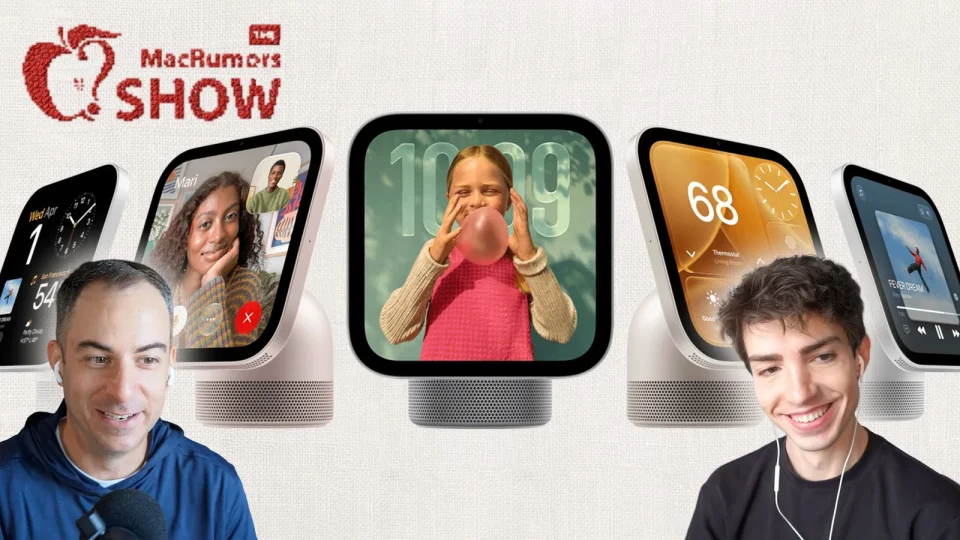
Apple this week announced three new products: the HomeView smart home hub, a HomePod mini 2, and an updated Apple TV 4K. On a recent episode of the associated weekly podcast, hosts and guests discussed the announcements and shared mixed reactions to what each device adds to Apple’s lineup.
HomeView: design, features and reception
HomeView costs $299 and combines a 7-inch square display with Siri AI, FaceTime, music playback, and smart home controls. Reactions among YouTubers and the wider Apple community have been mixed, with some criticism focused on what HomeView adds for users who already own an iPhone, iPad, Apple Watch, or HomePod. A screen for timers, photos, music and home controls will be useful for many, but it is harder to explain why someone wearing an Apple Watch would reach across a kitchen counter to set a timer or why they would type a message on HomeView instead of using their iPhone; Apple’s promotional video highlights some of those less convincing use cases.
The device offers several design details that drew praise: the display can show photos and customizable faces, dim to as low as 0.3 nits in the dark, and adapt its interface as someone approaches. In the kitchen, guided recipes convert webpages into step‑by‑step instructions, with voice‑controlled timers available during cooking. HomeView recognizes up to six people and switches to their apps and personal information; privacy protections mean personal content normally appears only when the user is recognized and their paired device is nearby and recently unlocked. Siri AI can answer general questions without an Apple Intelligence‑compatible device, but personal requests still require one.
There is no App Store on HomeView. Compatible third‑party audio and video apps appear through a connected iPhone or iPad using a CarPlay‑like system, so services such as Spotify and Audible rely on another device rather than installing an app directly on HomeView. Apple offers a tabletop model and a wall‑mounted version; the wall‑mounted unit costs the same $299 despite losing the tabletop model’s speaker base, woofer and passive radiators. Mounts start at $59.95, and the retail box includes no power adapter or cable. HomeView could serve as a direct replacement for an Echo Show or Nest Hub for users frustrated by poor ecosystem integration or ads on other smart displays, but for people who never wanted a smart display it may be less obvious what Apple has added to change their minds.
HomePod mini 2: incremental upgrades and timing
Six years after the original HomePod mini, the HomePod mini 2 retains the same basic speaker hardware while adding an S10 chip, Sound Glow lighting, and support for Siri AI. The new speaker is priced at $149, roughly 50% higher than the original $99 launch price and following an interim June price increase to $129. The new HomePod mini 2 can serve as a default Mac speaker on Mac models with Wi‑Fi 6E or later. Siri AI is expected to make a larger difference to everyday use, but Apple said Siri AI support will arrive later, after the speaker launches on October 30.
Apple TV 4K: higher price, familiar upgrades
The updated Apple TV 4K is priced at $299 and adds an A19 chip, built‑in microphones, and an updated Siri Remote; the new remote can also be purchased separately for $59. Apple said Siri AI support will come to older Apple TV models as well. The new Apple TV 4K includes 128GB of storage, Ethernet and Thread. The starting price is now more than twice the $129 entry point available before June’s increases, and an equivalent outgoing model had already reached $249, making $299 a substantial outlay for a streaming box when many existing owners have little reason to upgrade.
One upgrade reason is surround sound support for four HomePods: the new Apple TV can use matching front and rear pairs of HomePod mini 2 or second‑generation full‑sized HomePods. At Apple’s U.S. prices, buying the new Apple TV, two full‑sized HomePods and two HomePod mini 2 speakers totals $1,295.
Accessories, Apple Home Collection and other hardware
The Apple Home Collection, developed with LG and Schneider Electric, adds another series of premium accessories that include one‑tap setup and a lock that uses Ultra Wideband to unlock as someone approaches. Whether those features justify paying more than for other HomeKit accessories will depend on buyer priorities and the cost of equipping an entire home. Apple is reportedly still working on a robotic home display and its own camera, separate from the LG and Schneider products; the camera is said to detect activity and presence without recording video.
Rumors and related product discussion
The episode also looked ahead to an expected OLED MacBook, where a lighter design and a new display could matter more than a touchscreen; that machine is expected to be announced later this month. The hosts briefly revisited the iPhone Duo rumors, discussing whether a folding display and software changes make a more convincing case for a new form factor.
Where to follow the discussion
The weekly podcast discussed these topics and is available on Apple Podcasts, Spotify, Overcast and other podcast apps, and via RSS. Frequent guests on the show include Tyler Stalman, Michael Fisher, Kayci Lacob, Kevin Nether, John Gruber, Mark Gurman, Jon Prosser, Luke Miani, Matthew Cassinelli, Brian Tong, Quinn Nelson, Jared Nelson, Eli Hodapp, Mike Bell, Sara Dietschy, iJustine, Jon Rettinger, Andru Edwards, Arnold Kim, Ben Sullins, Marcus Kane, Christopher Lawley, Frank McShan, David Lewis, Sam Kohl, Federico Viticci, Thomas Frank, Jonathan Morrison, Ross Young, Ian Zelbo and Rene Ritchie. The episode also recommended subscribing to the show’s YouTube channel for new episodes and clips.
