

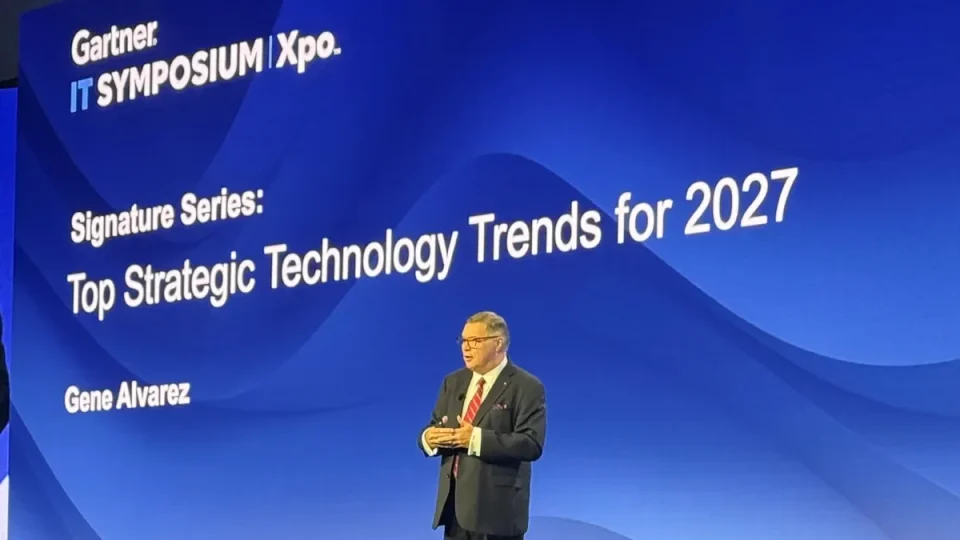
Gartner analysts released their list of the top 10 strategic technology trends for 2027 at the company’s IT Symposium/Xpo, highlighting a strong emphasis on AI governance, security and cost control that CIOs should prioritize now, according to Amanda Hetler, senior editor of Reader Engagement and Outreach.
Strategic tech trends CIOs should note
Gartner’s ten trends span near-term, implementation-ready technologies and longer-term, experimental ideas. Amanda Hetler said Gartner identifies these trends “by venture capital funding, patents, analyst submissions, innovation profiles and its own hype cycles” to determine what is gaining traction across IT.
The list of trends, in the order discussed, comprises: large quantitative models (models that can process equations with math and physics rather than relying solely on contextual language), speech reasoning models (which analyze audio and vocal inflection to escalate calls based on detected frustration), world models (physical AI and physics-based simulation to predict outcomes), AI context platforms (centralized stores of organizational information used to supply accurate context to models), agent coding harnesses (control planes that manage how autonomous code-writing agents operate), AI agent identity (limits and controls on what programs AI agents can access), autonomous exposure remediation (AI and automation that scan for and fix vulnerabilities), sovereign tech (tools and architectures to retain control over hardware, software, data and models), disposable applications (apps designed with a predefined end-of-life), and wetware as a service (the experimental use of living tissue and biological neural networks in place of silicon).
Hetler described agent coding harnesses and AI context platforms as already being deployed by organizations to help manage AI development and governance, while world models and wetware as a service remain in pilot or early experimental stages.
Security, governance and cost pressures
A central theme of Gartner’s list is the risk of AI advancing faster than organizational controls. Hetler said this year’s trends “reflect a strong concern about AI operating without structure, accountability or governance.” Gene Alvarez, a vice president and analyst at Gartner, characterized AI as operating within an “architectural vacuum,” signaling urgency for companies to design boundaries and governance rather than passively adopting capabilities.
Gartner warned that ungoverned AI agents could cause 25% of enterprise breaches by 2028. Organizations are already responding by moving security from an afterthought to an embedded capability: building continuous automated vulnerability remediation into software development lifecycles rather than relying solely on manual review.
Cost is another pressure point. Hetler reported Gartner’s finding that companies are spending 18 times more on AI than they did two years ago, and many IT leaders lack a dedicated AI budget. That has driven calls for stronger ROI discipline: using the right model for the right task, setting token limits and avoiding unnecessary expenses on oversized models.
Practical priorities for CIOs
Hetler urged CIOs to prioritize governance infrastructure now: establish identity controls for AI agents, adopt agent coding harnesses to standardize and oversee autonomous code generation, and invest in AI context platforms so models operate on accurate, organization-specific data. She recommended clear accountability structures that distinguish who is responsible for AI operations and who is ultimately accountable for outcomes, plus tracking of AI agent activity.
CIOs should also evaluate long-term cost and vendor-dependency risks—areas where Gartner highlights sovereign tech—and implement cost controls to limit token consumption and match model complexity to task requirements.
Hetler concluded that many organizations are shifting from rapid adoption to disciplined implementation: embedding security and governance, ensuring data readiness, and prioritizing technologies that deliver measurable value while containing risk. Kate Murray is noted in the source as an editor on the Reader Engagement and Outreach team involved in coverage of the event.
