

At a major Silicon Valley AI summit, Nvidia’s longtime leader Jensen Huang resigned as CEO of the company he founded 33 years ago following reports of extramarital affairs, including one with a woman suspected by US intelligence of spying for China. Nvidia named its longtime CFO, Colette Kress, interim CEO. The announcement dominated conversations among founders, investors and executives gathered to discuss AI’s future.
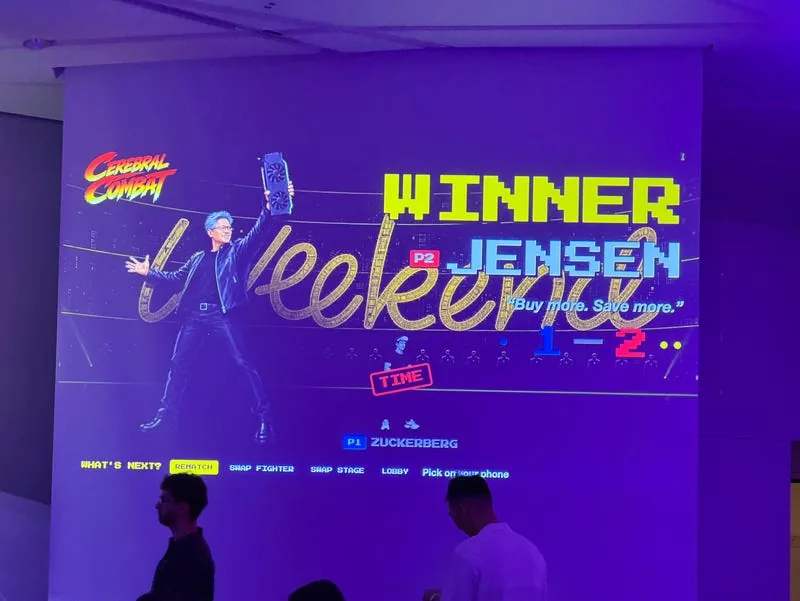
The conference offered a surreal contrast: in an arcade game called “Cerebral Kombat,” an Nvidia cofounder could knock down Meta CEO Mark Zuckerberg with a giant GPU, while offscreen Huang’s departure unsettled attendees. One venture capitalist asked Katie Roof whether she was attending Huang’s funeral — a joke that masked deeper worries about what his abrupt exit means for the AI boom.
Ali Ghodsi, CEO of Databricks, said onstage that Huang had become something of a safety net for AI startups. “On the margin, I think that starts hurting a lot of startups,” Ghodsi said, arguing that Huang often reassured investors and helped keep the industry moving when concerns about a bubble arose.
Nvidia’s central role in the AI industry
Under Huang, Nvidia grew into a major investor and influence in the AI ecosystem, earning a reputation as the “central bank of AI” for its willingness to bankroll startups that often also buy its chips. That influence surfaced at the summit when venture firm Bessemer Venture Partners and the event organizer unveiled a list of the world’s 100 most important private AI companies; Nvidia had invested in 42 of them, according to Bessemer partner Talia Goldberg.
Hemant Taneja, CEO of General Catalyst, compared Nvidia’s importance to that of the big banks during the 2008 financial crisis, suggesting the company had become “too big to fail” and warning that a messy leadership transition could have wide consequences. “This is not a normal company,” he said onstage.
Nikesh Arora, CEO of Palo Alto Networks, focused less on the technology and more on Huang himself, calling him an unusually generous industry champion who lent time and influence to efforts ranging from open-source AI to cybersecurity. “Is there short-term instability in the moment? Most likely, because there’s a whole bunch of parts of the ecosystem which need to reexamine where their champions are,” Arora said.
Guillermo Rauch, CEO of Vercel, expressed concern about the future of Nvidia’s support for open-source AI. In September, Nvidia agreed to acquire Hugging Face, a popular platform for sharing open-source AI models, for nearly $13 billion. “An Nvidia without Jensen is going to be, I think, a challenging one,” Rauch said, though he hoped the company’s partnerships might preserve Huang’s vision.
For founders with close Nvidia ties, uncertainty was immediate. Zuzanna Stamirowska, CEO of Pathway, said Nvidia had been an unusually attentive partner, with employees constantly looking for collaboration; whether that culture would persist without Huang remained unknown. Hassaan Raza, CEO of Tavus, warned that any stumble at Nvidia could set back U.S. AI ambitions. “If Nvidia misses a quarter in the next year or something, oh my gosh, it’s going to be a bloodbath,” Raza said.
Aravind Srinivas, CEO of Perplexity, which counts Nvidia among its largest investors, said he had met with Nvidia executives earlier the same day and found business proceeding as usual. He noted Nvidia’s technological advantages: “Even now, the best GPUs for running inference is Nvidia, and the best GPUs for running training is Nvidia, and none of that stops. It’s established for years in the future.”
Ghodsi added that Nvidia should remain strong for at least another two or three years because of long chip development cycles, but he and others questioned what would come after that horizon.
Competitors and chip challengers saw opportunity in Huang’s abrupt exit. Robert Wachen, cofounder of Etched, praised Huang’s contributions but said the departure could open a path for rivals: “Now we see there’s probably going to be a big opening, which we plan to capitalize on.” Taneja suggested the upheaval could push startups to explore alternatives from AMD and Google rather than relying so heavily on Nvidia. Raza agreed but added, “This is not the best way to do it,” noting that being forced into alternatives was not ideal.
By the end of the summit day, conversations mixed confidence in Nvidia’s entrenched technological position with concern about the company’s future leadership and the ripple effects the sudden change could have across the AI ecosystem.
