

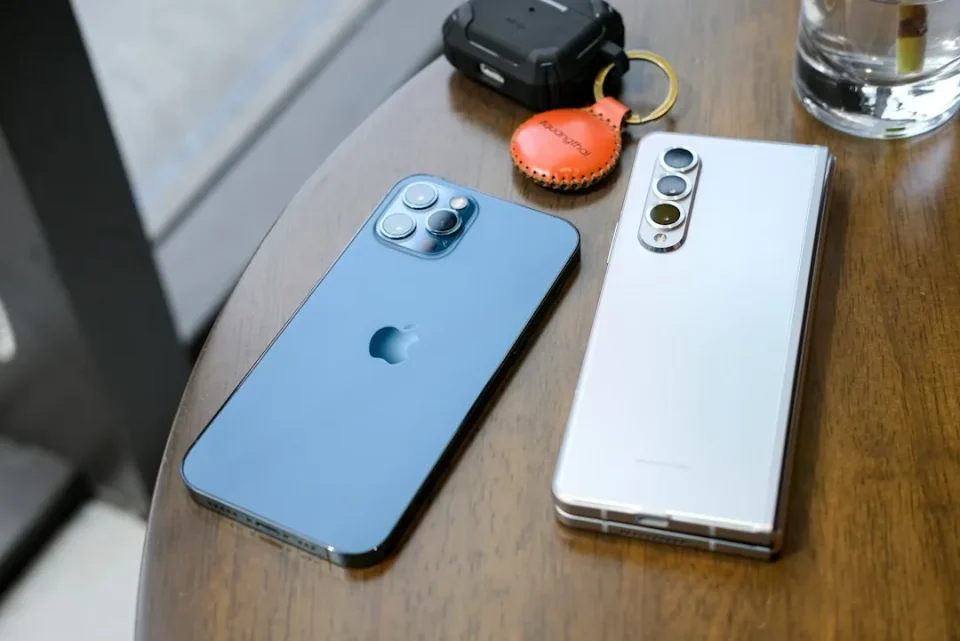
The iPhone Duo vs Galaxy Z Fold8 comparison highlights two similarly sized foldables with different design choices, feature trade-offs, and ecosystem implications. Samsung launched the Galaxy Z Fold8 a few months before Apple released the iPhone Duo, and the two now compete directly in the large foldable segment.
iPhone Duo vs Galaxy Z Fold8: Design and display
The Z Fold8 is noticeably lighter—about 50 grams less—because it is thinner both folded and unfolded, while the iPhone Duo has a heftier, more premium build with rounded corners compared with the Fold8’s sharper rectangular corners. The Z Fold8 is roughly 6 mm taller and about 3 mm narrower than the Duo; both use a 7.6-inch inner display. Apple applied a matte nano-texture display on the iPhone Duo to reduce crease visibility and placed the camera under the inner screen. Samsung previously experimented with under-display cameras but uses a traditional hole-punch front camera on the Z Fold8.
Cameras and biometric options
Neither phone includes a telephoto camera. The iPhone Duo has a 48-megapixel main camera and a 48-megapixel ultra-wide, while the Z Fold8 uses 50-megapixel wide and ultra-wide sensors. The main image-quality differences come down to each phone’s computational processing and user preferences for white balance, saturation and tone. Under-display front cameras are generally lower resolution than standard cameras, and there have been complaints about the iPhone Duo’s inner front camera; the Z Fold8’s hole-punch front camera is described as higher quality. Both devices use fingerprint recognition rather than Apple’s Face ID, but Samsung has long offered a face-unlock feature using the front-facing camera. Apple adopted a similar face-unlock option arriving in iOS 27.3; that face unlock is less secure than Face ID but can be more convenient than Touch ID for some users.
Performance, features and software
Samsung equips the Z Fold8 with the Qualcomm Snapdragon 8 Elite Gen 5, while Apple fitted the iPhone Duo with the A20 Pro chip. The Z Fold8 supports 8K video recording and reverse wireless charging for accessories and includes a physical SIM; the iPhone Duo uses eSIM only. Water and dust resistance differ: Samsung rates the Fold8 at IP48, and Apple rates the Duo at IP68. Stylus support is another difference: the iPhone Duo works with the USB-C Apple Pencil, whereas the Z Fold8 does not work with Samsung’s S Pen options.
Software and app readiness also diverge. Samsung has produced foldables for years, giving developers more time to optimize apps for the form factor; most Android apps already work well on the Fold8. By contrast, many developers have yet to update their apps for the Duo. Samsung also offers more multitasking options on the Fold8, including the ability to run three apps at once, pop-up windows and a taskbar.
The Z Fold8 starts at $1,899.99, while the iPhone Duo starts at $1,999. Choosing between them will largely depend on your operating system preference and device ecosystem: iOS users invested in an Apple Watch, Mac and other Apple devices will have little reason to switch to Samsung, and the same applies for users tied to Samsung’s Galaxy ecosystem.
