

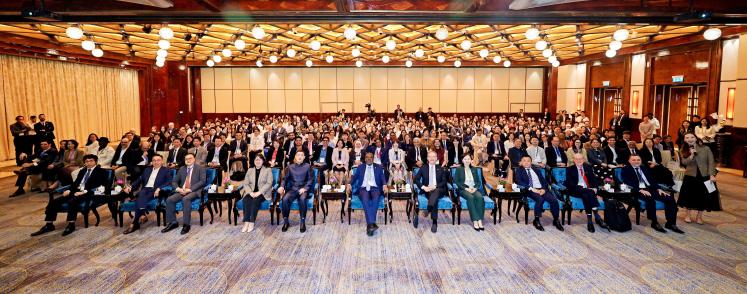
The UNU Macau AI Conference 2026 advanced a human-centred approach to AI education, placing Global South experiences at the core of its agenda and linking policy, practice and youth innovation. The event’s open call received 340 submissions from 74 countries and regions, nearly three-quarters coming from the Global South; organisers selected 16 thematic sessions that foregrounded those perspectives.
AI education: Global South at the centre
Panels and parallel sessions examined structural questions reshaping modern education, including credentialing and employability—validating authentic learning and human competence in AI-mediated environments as workforce demands shift; governance and accountability—establishing legal frameworks, higher-education governance, information integrity, and clear lines of responsibility when automated systems influence educational outcomes; and equity and co-design—advancing inclusion in K–12 and low-resource education systems, safeguarding cultural and natural heritage, and co-designing multilateral AI education standards with, rather than for, the Global Majority.
Anchoring dialogue in Macau and the Greater Bay Area
The conference combined global engagement with local and regional collaboration. Support from the Macao SAR Government and DSEDJ aligned international policy debates with Macau’s long-term talent-development and educational priorities. UNU-IIST and DSEDJ have jointly delivered AI education training for Macao’s primary and secondary school teachers to strengthen classroom capacity for responsible AI integration. MGM’s partnership provided a platform uniting UN entities, government ministries, universities, industry and civil society, while ASEF’s parallel ASEFNextEd convening brought education leaders and teacher educators from across Asia and Europe to Macau during the same week.
“The SAR Government actively aligns with national strategies, advancing the integrated development of education, science and technology, and talent, while progressively expanding AI education across all levels. Leveraging the advantages of ‘One Country, Two Systems’, Macao is advancing the Macao–Hengqin International Education (University) Town and deepening cooperation with the Greater Bay Area and Hengqin. At the same time, Macao will continue to serve as ‘One Centre, One Platform, One Base’, supporting international academic and technological cooperation and working with partners to advance equitable, inclusive, responsible and sustainable AI,” said Iun Pui Iun, Deputy Director of the Education and Youth Development Bureau.
“AI is evolving rapidly, but people remain at the heart of technological progress. At MGM, we believe embracing new technologies must go hand in hand with nurturing talent and fostering an innovative mindset. This belief underpins our continued efforts to bring technology and humanity together, explore innovative applications in tourism, and advance youth development and lifelong learning. Through this conference, we are delighted to deepen our collaboration with UNU-IIST, bringing leading ideas in technology and education to Macau and creating more opportunities for young people in Macau and across the Greater Bay Area to engage in global exchanges,” said Kenneth Feng, CEO and Executive Director of MGM China Holdings Limited.
“The future of AI in education is not simply about what technology can do, but about how we empower people to shape its use. Through ASEFNextEd, we are bringing together education leaders from Asia and Europe to rethink how future teachers are prepared, strengthen human agency and professional judgement, and translate collective knowledge into meaningful policy and practice. Our collaboration with UNU-IIST reflects a shared commitment to ensuring that educational innovation remains inclusive, responsible and fundamentally human-centred,” said Reka Tozsa, Director, Education Department, ASEF.
Approximately 150 participants from Macau and the Guangdong–Hong Kong–Macao Greater Bay Area engaged directly with international research, policy perspectives and practical approaches to AI education, contributing local experience to the wider discussion and linking global expertise with regional needs.
Youth innovation: Global reach, local talent
Young innovators featured prominently. Day Two hosted the final round of the AI for SDGs – Global Youth AI Future Innovation Competition 2026, an initiative launched by the UNU Global AI Network and co-organised by Venture Cup China with local support from Macao Computer Society. From 314 applications from 128 countries and regions, 12 international finalist teams from 10 countries and regions pitched solutions across three tracks—AI for Education, AI for Social Innovation, and AI for Less Developed Countries—and were joined by three Gold Award-winning teams from the Macao Secondary School Division. Macau youth teams competed alongside international finalists and were evaluated on technical sophistication and their capacity to address community needs and generate measurable public value.
From policy to practice: workshops, training and proceedings
The AI × Education Workshops and Training programme engaged about 200 attendances across 12 interactive sessions organised under three tracks: Education and Learning Innovation; Technology, Society and Policy; and Simulation and Applied Learning for Youth. Participants worked through practical modules covering critical and computational thinking in the age of AI, responsible K–12 learning design, institutional readiness for AI integration, and the deployment of agentic AI from technical foundations to real-world applications. Additional sessions explored AI-powered Model UN simulations through Remodel UN and the evolving landscape of global AI governance.
Selected papers and discussions from the conference will be published as proceedings in the UNU–Springer Book Series, linking international convening with scholarly publication and practical capacity building to support long-term value for Macau, the region and the wider United Nations system.
Over two days in Macau, sessions, workshops and proposals from young innovators contributed to shared momentum toward inclusive and responsible AI education. UNU-IIST will build on these exchanges, working with local and global partners to advance an inclusive, accountable and human-centred AI future.
About UNU-IIST
Founded in 1992, the United Nations University International Institute for Software Technology (UNU-IIST) is one of the 13 research institutes of the United Nations University and the only United Nations entity in Macau. As an international think tank at the intersection of digital technology and sustainable development, UNU-IIST focuses on AI research, education and training and places strong emphasis on youth development through internships, training and education programmes. UNU-IIST is grateful for the long-standing support of the Macao SAR Government and the wider Macau community and will continue to serve as a bridge supporting Macau’s internationalisation, technological innovation and youth education.
