

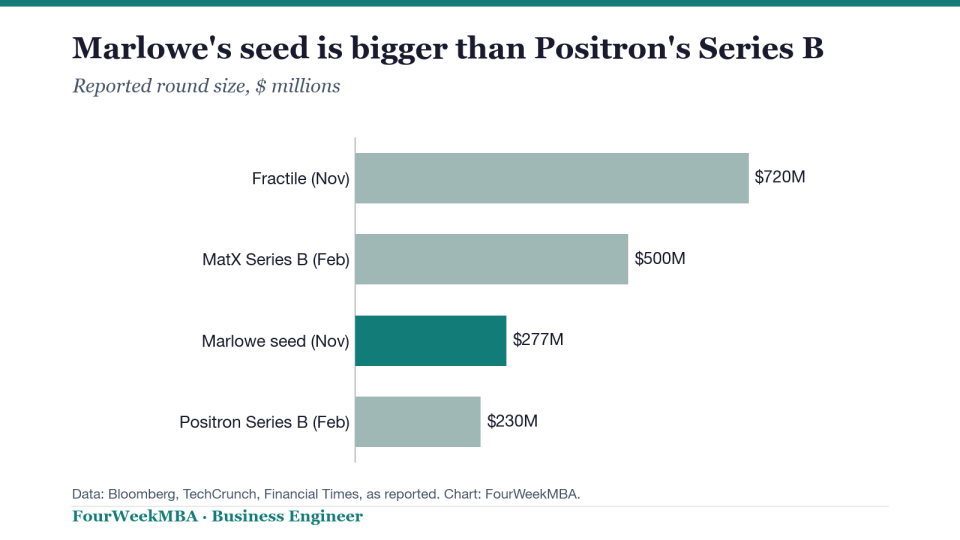
Marlowe has raised a $277 million seed round at a $1.15 billion valuation, the company announced on November 23, 2026. Accel led the round for the six‑month‑old AI infrastructure startup, which was founded in May 2026 by Microsoft veterans Dan Lewis and Kutta Srinivasan.
Marlowe funding round
The $277 million figure is the total seed amount and includes a smaller, earlier tranche led by Eclipse; Marlowe has not disclosed how much came from each part. The valuation is the figure Marlowe provided, and Accel posted a note on the same day the company announced the deal.
Investors in the round include Bessemer Venture Partners, Altimeter, Atreides, Eclipse, Journey and Valor, with additional participation from Neo, Scribble, Emergence Capital, Ritual, Pitango, Village Global and Banter. Angel backers named in the raise include Box CEO Aaron Levie, Uber CEO Dara Khosrowshahi and KKR co‑founder Henry Kravis, along with Nikesh Arora, Drew Houston and Tony Xu.
Founded in May 2026, Marlowe is headquartered in Bellevue, Washington and Redwood City, California, and has a headcount close to 30.
Leadership and origins
Dan Lewis serves as CEO. He co‑founded freight marketplace Convoy, which reached a $3.8 billion valuation before it shut down in 2023. Lewis later became a corporate vice president at Microsoft and left in June 2026. Lewis said Microsoft’s AI capacity was “always oversold, effectively sold out,” a shortage Marlowe aims to address.
Kutta Srinivasan is CTO; he was Microsoft’s company‑wide technical lead for AI infrastructure and previously spent eight years at Valve, worked on machine learning infrastructure at Facebook and served as a technical fellow at LinkedIn. Eclipse founder Lior Susan is executive chairman, DriveNets founder Ido Susan sits on the board, and Stanford professor Chris Ré is a founding advisor.
Technology and operations
Marlowe describes its offering as a “multi‑silicon AI factory”: it designs, builds and operates its own inference sites (the stage where trained models answer queries) rather than training models. The company selects a chip mix for each job and optimizes network, power, server software and model routing around those chips. Today Marlowe runs inference on chips from AMD and Etched instead of Nvidia; the company does not use Nvidia hardware today but has not ruled it out.
For its second site, Marlowe plans to deploy AMD Helios racks, with each rack pairing 72 AMD GPUs with AMD CPUs and Pensando DPUs, and Broadcom supplying the networking.
Marlowe claims its approach delivers two to three times more output per watt and per dollar than standard GPU clouds. That 2x–3x figure is a company claim and has not been independently verified. The company provided a breakdown showing how small percentage gains stack: four compounded layers of 10%–20% improvements produce about 1.46x–2.07x overall; reaching 3x would require seven layers at 20% each or twelve layers at 10% each.
Data center plans and customers
Marlowe has three sites in the works, each planned at tens of megawatts, and says it will fund new capacity one site at a time. The announced timeline and hardware is: site 1 with Etched inference chips due December 2026; site 2 with AMD Helios racks due Q2 2027; site 3 hardware not disclosed but a letter of intent has been signed.
The main user of the first site will be a large AI coding company that Marlowe has not named. The startup says it has three signed customer agreements but has not disclosed customer identities, contract values or site locations.
Why investors backed Marlowe
A $277 million seed is unusually large for a first round, reflecting the capital intensity of building data centers before the first customer goes live. Marlowe plans to spend the funding on hardware and engineers. The wider market has seen large checks for inference chips this year: Etched raised $700 million at a $21 billion valuation in August 2026, and rounds for other inference‑chip companies in late October added more than $1.3 billion. Marlowe announced its seed the same day another major AI infrastructure company closed a $1.75 billion financing.
