

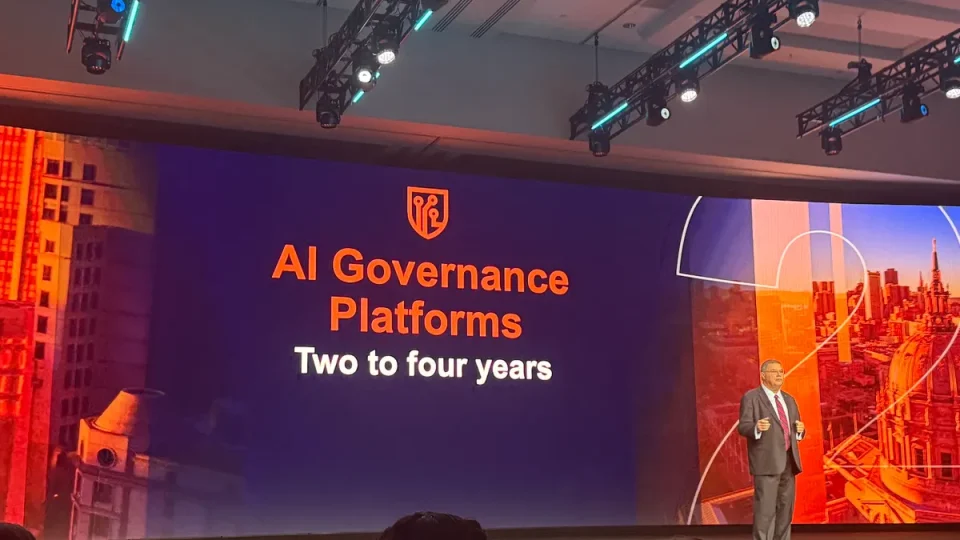
ORLANDO, Fla. — CIOs must become “active architects” as AI systems evolve faster than humans can review them, Gene Alvarez, distinguished VP analyst at Gartner, said Tuesday during a session at the company’s IT Symposium/Xpo. Alvarez said AI is being developed “in an architectural vacuum,” producing unmanaged credential paths and steering companies toward single-source vendor monopolies. He outlined five technology trends, drawn from a review of venture capital investments in hundreds of emerging markets, patent submissions and analyst assessments, that CIOs should prioritize to shape their organizations over the next several years.
Establish AI agent identity
AI agent use and autonomy are growing in enterprises, with agents taking on tasks traditionally handled by employees and increasingly acting independently. Gartner predicted that by 2028 one-quarter of enterprise security breaches will trace back to AI agent abuse due to unmanaged machine privileges and legacy credential practices. For security reasons, Alvarez said CIOs should consider developing identities and boundaries for agents within the next year or so. Dynamic identity controls enable policy-controlled access, prompts and credentials to agents; “It’s about securing agents as enterprise workers,” Alvarez said.
Introduce AI coding harnesses
Alvarez recommended implementing coding harnesses—closed loop-control systems that govern autonomous developer behavior across the software development lifecycle—on a similar timeframe. Without dedicated harnesses, developers spend time manually verifying machine output, erasing productivity gains. “The AI coding harness determines, ‘Is it the right order? Are we using the models efficiently?'” Alvarez said. Harnesses will also enable agents to take on more complex coding workflows.
Assemble AI context platforms
Dedicated context layers give AI agents the organizational knowledge they need to interpret inputs, make decisions and act according to business objectives. Without that context, organizations face operational risks, compliance failures, low trust and excessive token consumption. Alvarez described these platforms as “ontologies based on your data, your processes, your policies that say, ‘How do we do business?'” Gartner predicted that by 2027 organizations that prioritize context in AI-ready data will increase agentic AI accuracy by up to 80% and reduce costs by up to 60%. Alvarez cautioned against one-size-fits-all vendor products and urged prioritizing open, interoperable devices.
Build for sovereignty
As enterprises increase technology spending, sovereignty over data, software and hardware is gaining importance. Creating architectures that allow realistic vendor exit strategies across the stack will become increasingly important, Alvarez said. He noted the European Union’s June unveiling of the European Technological Sovereignty Package and Gartner’s prediction that by 2030 more than 75% of non-U.S.-based organizations will adopt digital sovereignty strategies. “You have to figure out how to have a realistic vendor exit from everything in your entire stack so that you can be perpetually autonomous,” Alvarez said. “Residency is where your data sleeps, but sovereignty is the ability to wake it up at any time.”
Preparing for large quantitative models
Looking further ahead, Gartner estimated a transition from general-purpose large language models to large quantitative models in roughly five to eight years. Alvarez said enterprise adoption of large quantitative models will shift CIO decision-making from reactive troubleshooting to proactive simulation, enabling complex data-driven decisions with fewer resources than LLMs and improving model accuracy and reliability. He added that this rigorous approach could enable safe autonomous forecasting in strictly regulated industries such as finance and healthcare.
Alvarez emphasized that the advisory firm provided tentative timeframes and that each organization must “match the maturity of your organization to the timing of when you’re bringing this technology in.” The trends are intended to help CIOs move from passive oversight to active architecture as AI capabilities and associated risks evolve.
