

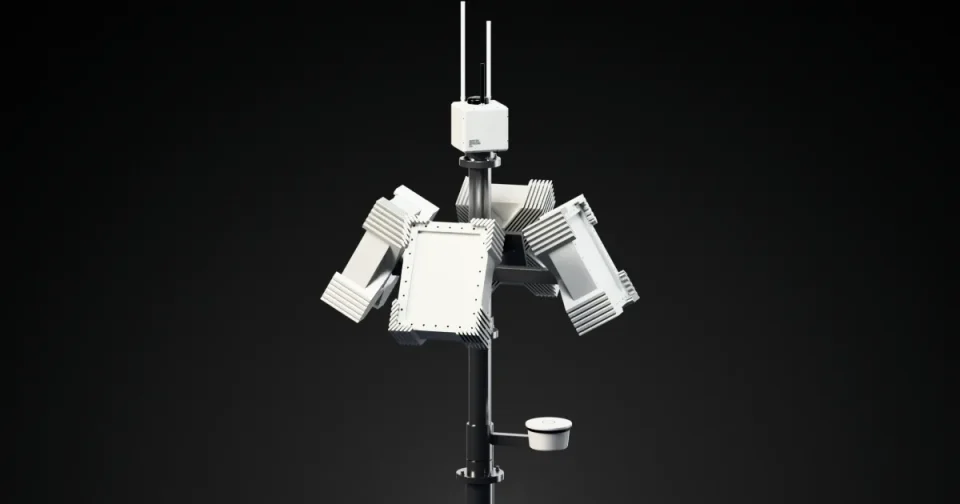
Austin Sensing Company emerged from stealth this morning with $15M in funding to develop a full airspace sensing stack, from RF detection to radar and acoustic sensors. CTO Isaac Duke said the effort aims to “enable all these counter-UAS platforms to be more effective and give operators greater awareness of the airspace.”
Bow Capital led an $11M seed round, joined by Bling Capital, Draper Associates, Mark VC, GTMfund, Ensemble VC and others. The remainder of the announced capital comes from a roughly $4M pre-seed round raised last year.
ASC is led by CEO Tucker Dordevic and CTO Isaac Duke. Dordevic previously worked in aerospace and defense banking and, until last year, was a professional lacrosse player who won the Premier Lacrosse League’s Rookie of the Year honor in 2023. Duke was an engineer at Austin defense startup Saronic. The pair began building ASC last year and launched their first product, an RF detection system, this past summer.
Austin Sensing Company’s multi-modal stack
ASC says its initial product lineup will fuse multiple sensing modalities:
– RF AS: A tripod-mounted RF detection system (AS stands for Austin Sensing) with 28 square miles of range per unit. ASC says the RF AS detects everything from manned aircraft at 40,000 feet to FPV drones and can provide insight into an operator’s location.
– Acoustic AS: An AI-powered acoustic classification system intended to detect and identify drones, including tethered systems, “across a full 360-degree field in under one second.”
– Radar AS: A compact radar designed to track manned and unmanned aircraft at ranges up to 3 km.
– Tower AS: A deployable tower that combines the sensors into a single unit to improve localization and tracking, particularly when deployed in a network.
ASC also offers a user interface and command-and-control product called Operator AS, which the company says is designed to integrate with other C2 platforms such as Anduril’s Lattice and Palantir’s Maven. Duke said the company chose to vertically integrate its software and hardware because, “From my experience, third-party integrations are never very robust, and so we’re vertically integrating our entire stack—we build the software, we build the hardware, we can turn all the knobs. We’re not blocked by someone’s supply chain or API limitations, so we have full reign over the technology and can customize it as we need and as the operators need.”
Deployment, customers and competition
ASC reports that the radar and acoustic systems are still in development and undergoing live testing, while the RF detector is already seeing field use. Dordevic said the RF platform is deployed with more than 40 police and fire departments across Florida, California, Oregon and New York, along with a “handful” of military units. He said the company started with public safety customers because they have “far less red tape and bureaucracy than the US military,” adding that they wanted to be dual-use and to develop a B2B SaaS go-to-market muscle: “We started out going the inverse route because we wanted to be dual-use, instead of just starting on the defense side. We also wanted to develop almost a B2B SaaS company go-to-market [strategy], and we’re developing that muscle for public safety.”
ASC says it has units deployed for testing with a few undisclosed customers and is ramping up production in a new 20,000-square-foot factory in Austin. The company will compete with established and well-funded drone-detection firms such as CHAOS Industries, Fortem, Hidden Level and Echodyne, and is betting that a full-stack, multi-domain sensing approach will be the key to winning customers once it expands beyond initial deployments.
