

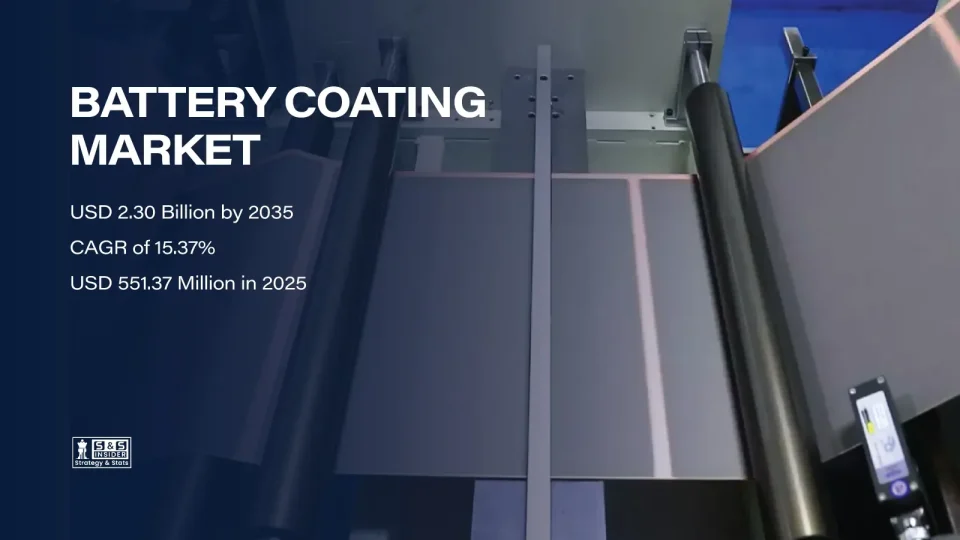
Battery coating demand is rising rapidly as cell makers add production for electric vehicles and energy storage: the global market was valued at USD 551.37 Million in 2025, is estimated at USD 636.12 Million in 2026 and is forecast to reach USD 2.30 Billion by 2035, a CAGR of 15.37% for 2026–2035.
Market size and forecast
The market’s projected growth to USD 2.30 Billion by 2035 reflects expanding cell capacity for EVs, buses, trucks and stationary storage. Key published indicators are: market size 2025 USD 551.37 Million; market size 2026 USD 636.12 Million; CAGR 2026–2035 15.37%. Asia Pacific led the market in 2025 with 62.37% share and is the fastest-growing region.
Drivers shaping demand
Manufacturers’ push for higher energy density and improved thermal safety is increasing the amount and precision of coatings required per cell. Separator coatings with ceramic layers are becoming more common because they help prevent short circuits at high temperatures. New regulatory and traceability rules are also influencing demand: China’s GB 38031-2025 standard imposes stricter safety tests for traction batteries, and the EU digital battery passport becomes mandatory in February 2027, requiring suppliers to document materials and processes more carefully. Stationary energy storage—particularly lithium iron phosphate systems—adds steady, ongoing demand.
Battery Coating components and materials
Electrode coating was the largest component in 2025, with a 46.38% market share; every lithium‑ion cell requires coated anodes and cathodes, and trends include thicker, high-energy electrodes that need high‑precision coating, water‑based binders, dry electrode processing, cathode surface coatings and inline thickness control. Separator coating is forecast to grow fastest, at a 17.64% CAGR during 2026–2035, driven by ceramic-coated separators that resist heat and shrinkage and by suppliers locating coating lines close to cell plants. By material, PVDF held a 33.72% share in 2025 and remains widely used as a cathode binder and separator coating while producers expand capacity; ceramic materials (alumina and boehmite) are expected to grow at a 17.28% CAGR through 2035, supporting heat resistance and solid‑state interface needs.
Battery types
Lithium‑ion batteries accounted for 72.41% of the coating market in 2025 and remain the dominant source of demand across consumer electronics, EVs and grid storage. Solid‑state batteries are projected to grow fastest among battery types, with a 21.83% CAGR during 2026–2035, as coatings for interface protection and compatibility with sulfide and oxide electrolytes are developed at pilot scale.
Key players and recent industry moves
Major participants in the battery coating market include Arkema, Solvay, Asahi Kasei, UBE Corporation, Toray Industries, SK IE Technology, Sumitomo Chemical, Mitsubishi Paper Mills, Tanaka Chemical, PPG Industries, Axalta Coating Systems, and Targray. Competition centers on material purity, coating consistency, local supply and support during cell qualification. Recent capacity actions cited include Asahi Kasei opening a wet‑process separator coating line in Charlotte, North Carolina (August 2026) and Arkema completing a 15% PVDF capacity expansion at Calvert City, Kentucky (June 2026).
Regional dynamics
Asia Pacific led the market in 2025 with a 62.37% share and is forecast to grow at a 17.21% CAGR through 2035, supported by China’s large cell and materials base and by Japan and South Korea’s advanced material supplies. Europe held 15.46% in 2025 and is expanding as new gigafactories in Germany, Hungary, Poland and the Nordics increase local demand; the EU battery passport (mandatory February 2027) favors suppliers able to document supply chains and run local production. North America accounted for 14.92% in 2025, with the United States at USD 73.52 Million for 2025 and a projected regional CAGR of 15.46%; suppliers are building plants near customers to reduce shipping time and trade risk. Middle East & Africa held 4.41% in 2025 with demand tied to solar‑linked storage projects, and Latin America held 2.84% in 2025 with growth linked to early vehicle and storage assembly and regional lithium resources.
Outlook to 2035
Through 2035, the battery coating market is expected to expand as EV production, energy storage deployment and stricter safety standards increase demand for separator and ceramic coatings. Water‑based processing and solid‑state battery development will create new coating applications, while success in the market will depend on material quality, safety performance, local supply and close collaboration with cell makers.
