

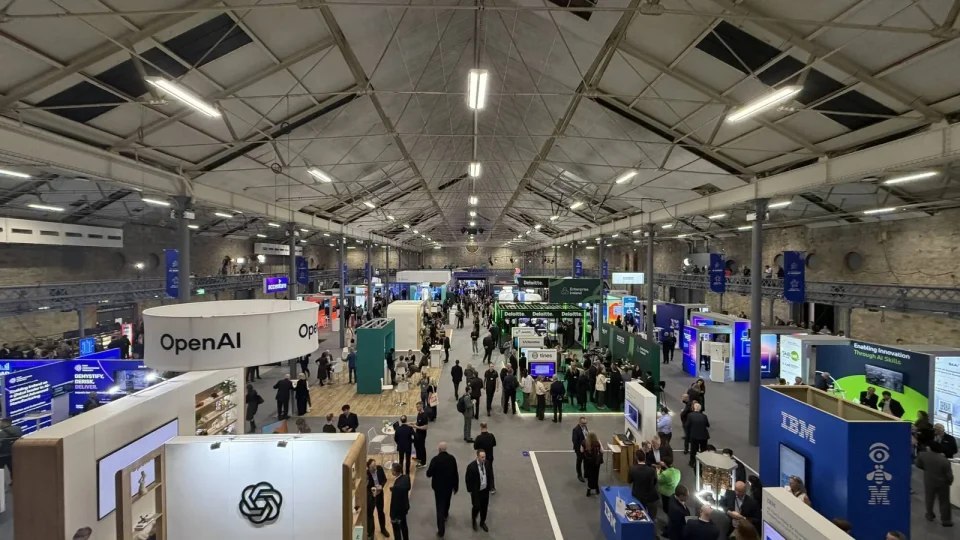
Standing on a strategically lit circular stage, backed by giant screens and the occasional burst of a smoke machine, Commissioner Henna Virkkunen opened the Government’s International AI Summit in Dublin by invoking Seamus Heaney’s poem Digging and setting out a vision of “a true, European AI Continent.” That theatrical opening framed a central question that ran through the event: who was the conference actually for?
Who was the Government AI conference for?
The summit felt like a national branding exercise staged for an international audience. Organisers presented a slick, frictionless production: QR-code entry, fast-moving queues and visible planning that kept protesters outside the gates and allowed tech executives and Irish and EU officials into the RDS halls. The Taoiseach delivered an opening address, but the capstone keynote was given by Microsoft, introduced by a minister. A Riverdance-inflected performance — dancers in shiny black crop tops combining Irish and contemporary moves, a bodhran alongside a transparent djembe and a sonic backdrop of U2 — reinforced the sense the show was designed as outward-facing theatre rather than purely domestic politics.
Who benefits from the Government AI conference spotlight?
Three organisations produced the summit: the IDA, which attracts foreign firms; Enterprise Ireland, which supports homegrown firms to grow and export; and the Department of Enterprise, Tourism and Employment, which funds and oversees the other two. The IDA and Enterprise Ireland represent two sides of a macroeconomic question: whether Ireland continues to build its fiscal wellbeing around overseas investment or pivots toward a domestic high‑tech industrial base.
On the exhibition floor, IDA-backed global companies dominated. A giant circular OpenAI banner hung over the hall, a Meta stand displayed its “smart” glasses, and Google staff invited officials to try a colourful stationary bicycle. Enterprise Ireland had a dedicated space showcasing six or seven Irish companies — occupying roughly the same floor area that TikTok used for a child-safety interactive quiz — and many Irish firms appeared in panels, while keynotes and firesides were largely given to global firms. Comand AI logos were pictured on a Unitree G1 humanoid avatar robot and a Go2 quadruped robot dog during the summit (file picture: Paul Faith/AFP/Getty). Delegates were also photographed in front of a TikTok poster at the event (file picture dated October 14: Paul Faith/AFP/Getty).
Emphasis, economic strategy and identity
For three decades Ireland has grown wealthy on foreign direct investment, and that model transformed the economy. The article notes, however, that the same strategy has introduced public finance precarity: IFAC warnings about overdependence on highly concentrated corporate tax revenue have become a familiar part of annual budget discussions. The summit’s allocation of prime real estate and headline slots to global household names — companies that arguably do not need the promotion — struck the author as the wrong emphasis at a moment when the country had a spotlight to shine on Irish innovation.
The piece argues there is no immediate binary choice between maintaining FDI and rapidly expanding support for domestic firms, but there is a choice about emphasis and the vision Ireland presents to the outside world. That debate about priorities links back to Virkkunen’s Heaney citation: Digging, the author writes, is about a struggle for identity, the uneasy handover between generations and the choice of tools. The summit’s spectacle invites reflection on who Ireland wants to be and what it wants to do with the shared future that AI promises — a question the author says remains after the smoke machines are packed away.
