

Korean mid-sized IT service companies are turning shop-floor data and operational expertise into domain-specific language models to serve manufacturing and logistics, moving away from reliance on general-purpose large language models (LLMs). CJ OliveNetworks, Asiana IDT, KOLON BENIT and POSCO DX are developing specialized AI models and services—through proprietary model development, fine-tuning, industry-data training and retrieval-augmented generation (RAG)—to address accuracy, cost, security and real-time requirements in industrial environments.
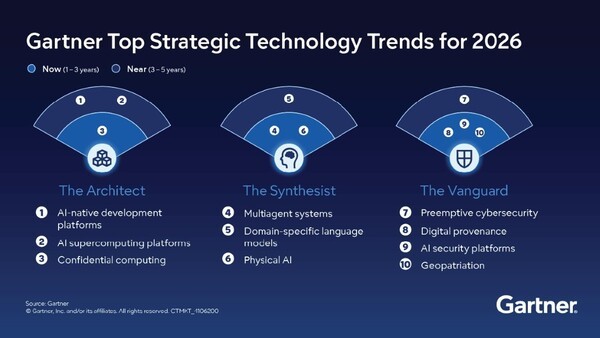
Domain-specific language models (DSLMs), sometimes implemented as smaller language models (sLLMs), are being promoted because they can learn specialized terminology and complex business logic used in a particular industry, reduce error rates and run with fewer computing resources. Gartner placed DSLMs among its Top Strategic Technology Trends for 2026 and, in a March 2026 report titled “Domain-Specific Language Models: GenAI as a Precision Tool,” said DSLMs can be developed at up to 50% lower cost than general-purpose LLMs. The firm also forecast that more than half of generative AI models used by enterprises will be domain-specific by 2028.
Strategy& has similarly identified domain-specific models as a component of physical AI, noting they can improve the reliability of robots and autonomous systems while reducing computing requirements and latency.
Manufacturing AI driven by shop-floor data
All four companies agree that manufacturing AI depends less on raw model performance than on the ability to use and integrate site data. They identify process and equipment data, production and quality records, shop-floor knowledge, documents and other unstructured data, CCTV and video, and existing enterprise systems such as ERP, MES and WMS as key inputs. Connecting and refining these disparate data sources into formats usable by AI is seen as critical.
CJ OliveNetworks said manufacturing sites require accurate answers based on interconnected structured data—production orders, product items, equipment tags, process conditions and quality standards—and warned that incorrect responses from general-purpose LLMs that fail to understand such data could directly lead to production disruptions or quality risks.
KOLON BENIT emphasized data fragmentation: production sites generate large volumes of data via SCADA, DCS and PLCs, yet equipment, quality, production and cost data often remain dispersed across separate systems. It argued that collecting, connecting and analyzing data must come first, and that data fragmentation and a lack of scalability—not model performance—are why many industrial AI transformation projects remain at the proof-of-concept stage. KOLON BENIT also listed applications that demand domain-specific models, including real-time video-based hazard detection, virtual sensing of physical properties, root-cause tracing for defects, automatic execution of a Golden Recipe that directly controls equipment, and standardizing experienced workers’ decision criteria—use cases it says general-purpose LLMs cannot reliably solve.
On-site training, security and edge inference for Manufacturing AI
Security and real-time performance are additional drivers for specialized models. POSCO DX said equipment operation and control can translate AI decisions into physical movements, requiring high accuracy and near-real-time inference; the company is positioning intelligent autonomous manufacturing and industrial-site AI as key business areas and favors lightweight domain-specific models that can make stable decisions within tight time constraints.
The firms described a preference for on-premises training and operation, edge inference at manufacturing sites and deployment in closed networks to prevent manufacturing data from leaving the customer’s environment. Asiana IDT said manufacturing and logistics sites need “practical execution intelligence” validated for security, accuracy and integration with on-site systems, and criticized general-purpose LLMs for frequent hallucinations and errors when processing complex document formats or integrating real-time visual data such as CCTV-based anomaly detection. Asiana IDT also raised concerns that using external cloud services risks leakage of confidential information and that model drift can degrade performance as production processes change.
Asiana IDT stated it uses internally developed tools to address these issues: EasyVibe, a closed-network AI coding assistant for secure coding and data analysis; ModelOps.Ai, a model performance-management solution that automates retraining to reduce operating costs; OnDoks, an AI OCR-based document-intelligence solution for extracting complex tables and forms; and ModelWave, an agentic AI platform that connects business knowledge with generative AI to provide fact-based answers.
CJ OliveNetworks highlighted four advantages of specialized manufacturing AI—security, real-time performance, accuracy and continuity—noting that edge AI architectures that run inference on servers near inspection equipment can minimize network latency and external dependencies. The company also pointed to the ability of specialized models to restrict data queries by user permissions, site and role, preventing direct access to operational databases.
All companies indicated the industry shift toward DSLMs is motivated by the need for higher accuracy, compliance with regulatory and security requirements, improved token-cost efficiency and the practical constraints of running AI in industrial environments. They are pursuing domain-data training, fine-tuning and retrieval-augmented approaches to gain competitive advantage in manufacturing and logistics AI.
