

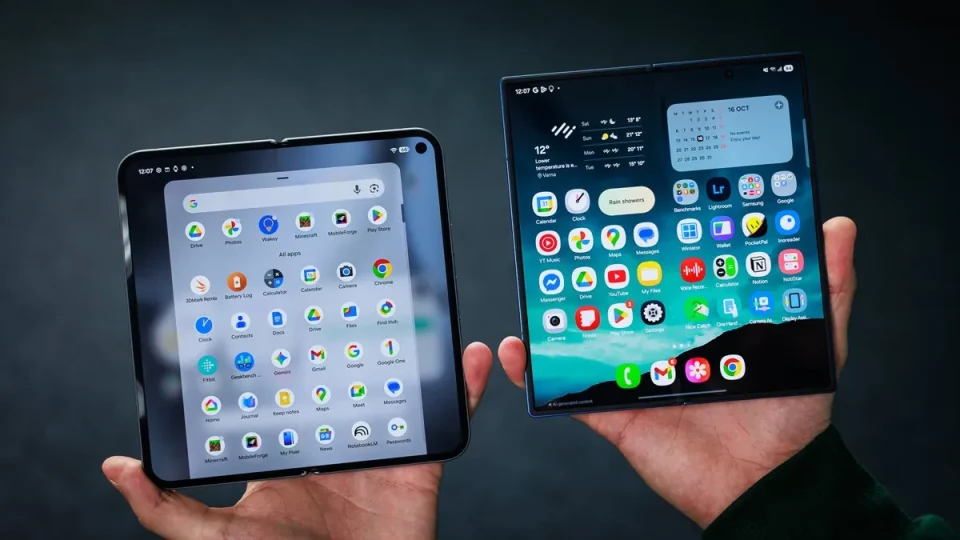
The iPhone Duo has put under-display cameras back in the spotlight: hiding the camera beneath the folding screen gives Apple’s foldable a cleaner look, but reviewers have criticized the picture quality.
Apple’s move echoes an earlier effort by Samsung, which tried under-display cameras years ago before ultimately changing course. Looking at Samsung’s implementations helps explain why the approach remains controversial.
Under-display camera: Samsung’s repeated attempts
Samsung introduced its first under-display camera with the Galaxy Z Fold 3 in 2021. That first camera used a 4MP sensor, and the resulting pictures were poor. The Galaxy Z Fold 4, Fold 5, and Fold 6 kept the under-display camera, but image quality never improved enough for the inner camera to become something users would regularly prefer.
Samsung later revised the design with the Galaxy Z Fold Special Edition, retaining the 4MP resolution but moving the camera to a conventional punch hole instead of hiding it beneath the display. The Galaxy Z Fold 7 then switched to a 10MP inner camera with a wider, 100-degree field of view. That setup continues on the Fold 8 and Fold 8 Ultra, while the cover screen camera offers an 85-degree field of view.
Cleaner screen vs usable image quality
A better inner camera widens the practical use of the under-display position by fitting more people into selfies and video calls, giving the inner camera a distinct purpose instead of duplicating the outer camera’s role. Still, a higher-quality inner camera cannot eliminate the visual trade-off: a punch hole is still a hole in the screen.
The appeal of hiding the camera remains for users who prioritize an uninterrupted large folding display. Widescreen video can often mask a camera hole behind black bars, whereas full-screen games, photos and some apps make any camera opening more noticeable. For those who seldom make video calls, accepting weaker images for a seamless screen can be a reasonable choice: both phones provide an external selfie camera, and rear cameras can also be used for selfies.
Samsung also undercut its own case with the Galaxy Z Fold 8, Apple’s direct competitor. Although the Fold 8 retains the wider inner camera, it lacks Flex Mode, so you cannot simply leave it half-open on a table for hands-free video calls or group selfies without an external stand. Only the Fold 8 Ultra supports Flex Mode.
The iPhone Duo’s hidden camera emphasizes screen continuity at the cost of image quality, while Samsung’s later models prioritize usable inner-camera optics and flexibility—illustrating the trade-offs manufacturers still face with under-display camera design.
