

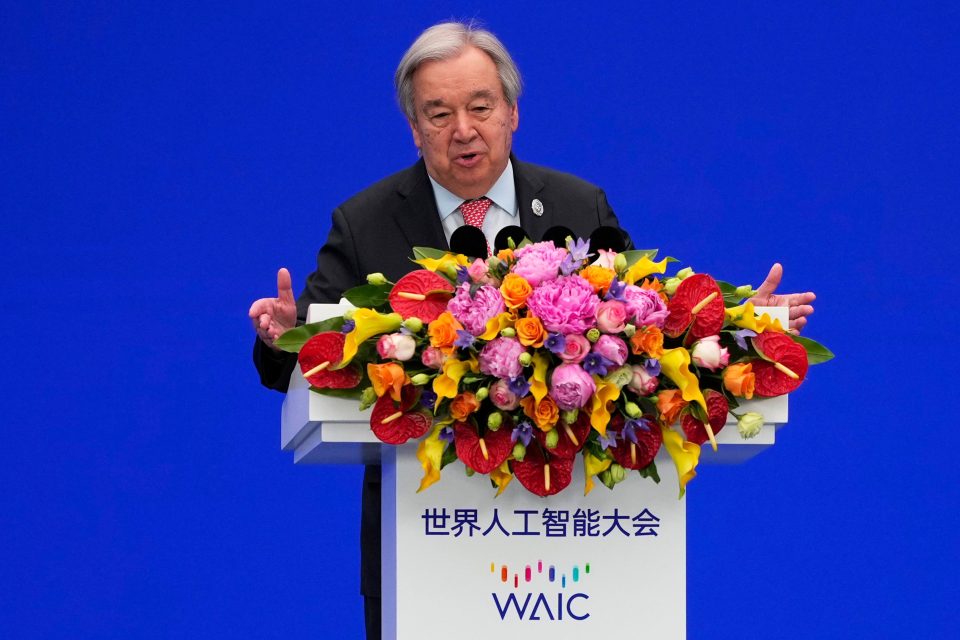
UN Secretary-General António Guterres on July 17 in Shanghai urged the establishment of global AI governance to prevent the technology from deepening inequalities and concentrating power in the hands of a few countries and corporations.
A call for inclusive AI governance
Speaking at the opening of the World Artificial Intelligence Conference, Guterres emphasized: “The technology that will shape the future of humanity must be shaped by all of humanity.” He thanked China for hosting the event and cited the Global Digital Compact as evidence that “neither a small number of countries nor a small number of companies should govern the future of this technology.” “Every nation needs a seat at the table,” he added.
Risks of inequality and the digital divide
Guterres warned that AI could be “the greatest opportunity of the 21st century — or one of its greatest risks.” He flagged the danger that AI may amplify inequality: “Compute power, data resources and technical expertise remain concentrated. Hundreds of billions of dollars in private investment are flowing into AI — while many developing countries receive only a trickle.” He also reminded the audience that a third of humanity remains offline, which risks widening the gap between the Global North and South.
Standards, human rights and safety
The UN chief called for cross-border rules grounded in international law: “Systems that cross borders need standards that cross borders. We need common approaches for testing, risk assessment and accountability.” He stressed the protection of human rights and the need to maintain human oversight in “every life-or-death decision.” On the use of AI with minors he was unequivocal: no AI system should be entrusted to a child until it has been proven safe.
Environment: transparency and the energy transition
Guterres also urged AI companies to publish the environmental impact of their systems. He noted that AI can accelerate the energy transition — through grid management, renewable integration and loss reduction — but warned that the technology’s growing demands for energy, water and land “must be brought into the open.” He called on “every major AI company” to disclose its environmental footprint.
