

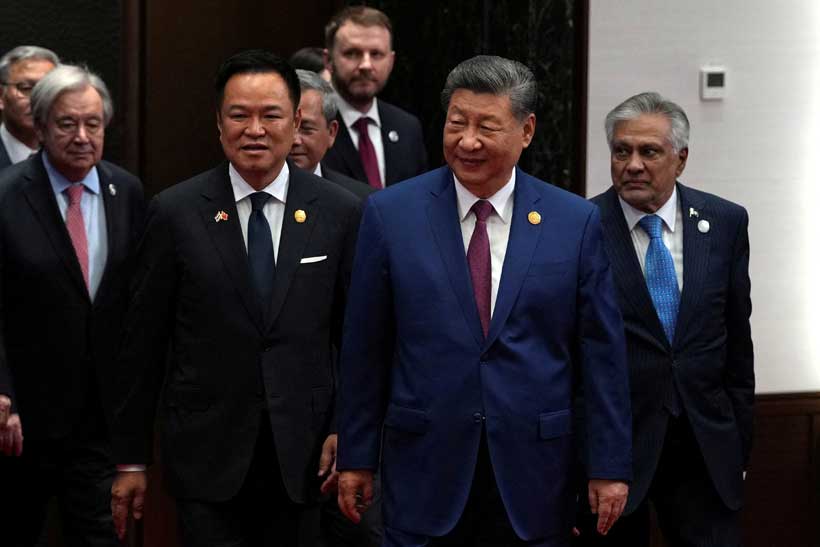
At the World Artificial Intelligence Conference (WAIC) 2026 in Shanghai, Chinese President Xi Jinping used his keynote to turn the principles of the Global AI Governance Initiative into concrete commitments, with a particular focus on developing countries. His speech formalized the creation of an intergovernmental body for AI cooperation and unveiled several skills- and infrastructure-transfer mechanisms intended to narrow the digital divide.
Key announcements at WAIC 2026
– Creation of the World Organization for Cooperation in Artificial Intelligence (WAICO), an independent intergovernmental organization headquartered in Shanghai, signed by 29 founding countries — including Brazil, Russia, Pakistan and Indonesia — together with ten African nations and twelve Asian states.
– Beijing’s pledge to deliver 5,000 AI training courses and seminars to developing countries over five years.
– Establishment of regional cooperation centers for AI applications in partnership with organizations such as the Arab League, the African Union, ASEAN and the BRICS.
– Sharing of China’s AI-driven weather alert system, MAZU, with 30 developing countries.
– A public rejection of the “politicization” of technology and a call for fair governance that resists tech monopolies.
A large-scale expo to match the ambition
WAIC 2026 was notable for its physical scale: over 100,000 m² of exhibition space — a record — hosting more than 1,100 companies and around 3,000 demonstrations. More than 300 products were unveiled as world premieres. Two major clusters — intelligent computing and embodied intelligence — each gathered over 200 companies. The event showcased 57 major application scenarios and produced memoranda of intent for cooperative projects totaling 16.2 billion yuan.
An approach framed as an alternative to the Western model
The speech and the announced initiatives outline an approach positioned as distinct from a Western regulatory-heavy framework. The reported differences include:
– Purpose: prioritizing the development of applications and sectoral integration over the exclusive focus on prescriptive rules.
– Accessibility: promoting open models and an open-source ecosystem to lower barriers to access.
– Infrastructure: sharing infrastructure via projects like the “Digital Silk Road” and joint data centers rather than relying on export controls.
– (Original French source truncated at this point — the likely intended point was about governance: calling for equitable, multilateral governance, capacity building for developing countries, and distancing governance from geopolitical competition and tech monopolies.)
If implemented, these measures aim to reframe AI cooperation toward capacity building, infrastructure sharing and applied deployment — potentially reshaping the geopolitics of AI and narrowing the global digital divide.
