

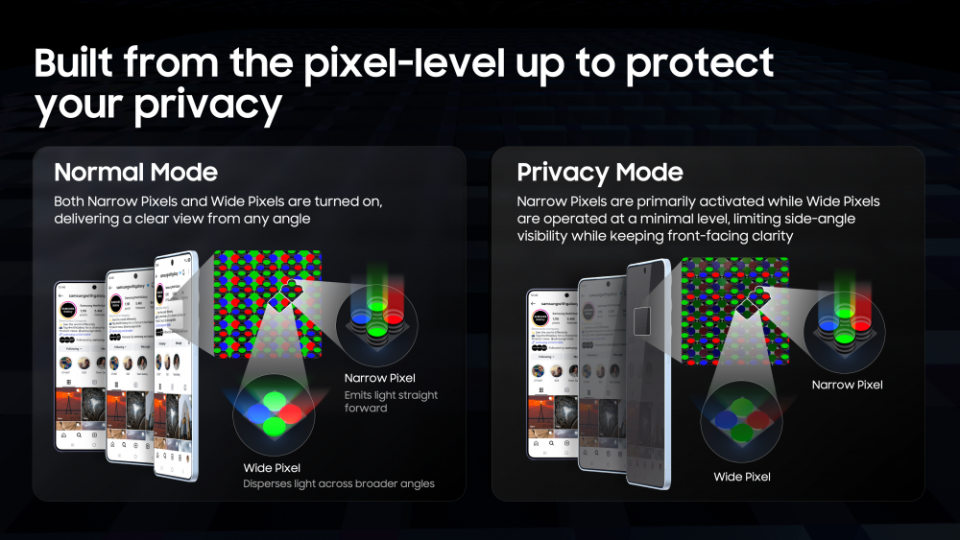
Samsung introduced the Privacy Display this year on the Galaxy S26 Ultra — an OLED panel engineered to limit lateral viewing angles. That privacy, however, comes at a cost: the panel is estimated to cost between $88 and $96 apiece, noticeably more than displays used in previous generations.
Privacy Display and cost: what the numbers say
A recent report estimates the display used in the Galaxy S26 Ultra at $88–$96 per unit. By comparison, the Galaxy S23 Ultra’s panel was valued at $84; the S24 Ultra’s at $88; and the S25 Ultra’s panel ranged from $84 to $88. Based on those figures, the S26 Ultra’s display is roughly 9% more expensive than the S25 Ultra’s.
How the Flex Magic Pixel works
Manufactured by Samsung Display and marketed as Flex Magic Pixel, the panel uses two sets of RGB emitters. One set provides a wide viewing angle, the other a narrow viewing angle. A multilayer black matrix blocks light from the narrow-angle emitters toward the sides. When the Privacy Display is activated, only the narrow-angle emitters are driven, which reduces side visibility.
Production costs: extra steps and added complexity
Designing these specialized pixels requires additional TFT masks during the Color Filter on Encapsulation (CoE) process. Those masks introduce extra operations — deposition, etching and photolithography — which increase production time and the display’s manufacturing cost. These technical steps largely explain the higher per-unit price of the panel.
Potential rollout to the S27 series
For now, the Privacy Display appears to be exclusive to the Galaxy S26 Ultra, but Samsung could expand the technology across future S-series models.
