

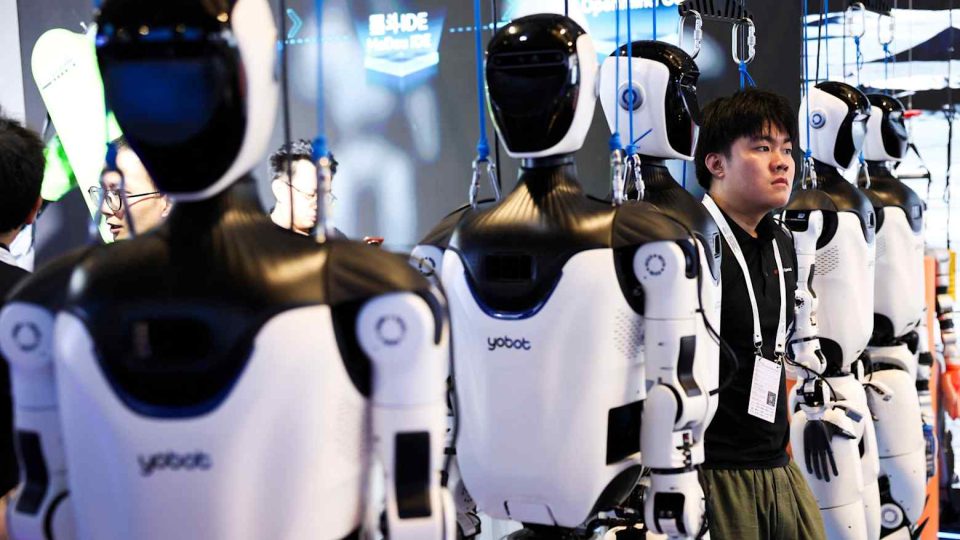
U.S. federal regulators have announced an import ban targeting new foreign-made humanoid robots and power inverters, citing cybersecurity risks and supply-chain vulnerabilities. The measure, driven by the Federal Communications Commission (FCC), primarily affects manufacturers based in China and comes just weeks before a planned visit by the Chinese president to Washington.
Scope and limits of the humanoid robot ban
The FCC says the ban applies to “new versions” of humanoid robots as well as quadruped robots—commonly called robot dogs. Officials point to national security concerns tied to cybersecurity and to the exposure of U.S. supply chains when production takes place overseas. The prohibition appears not to block continued use of devices already in the field or the sale of models that have already been approved for the U.S. market.
A measure that primarily targets China
China accounts for a large share of the global humanoid market—roughly 85% by the figures cited—and several major Chinese firms have sharply increased shipments. Research firm Omdia is cited as saying Unitree and AGIBOT each shipped more than 5,000 units in 2025, compared with only a few hundred from U.S. players such as Tesla or Figure AI. Analysts note that cutting off these firms from the U.S. market removes a significant outlet but is unlikely to halt China’s broader development in the space, given strong domestic production and other international markets.
Official rationale and implications for power inverters
In addition to robots, the ban covers power inverters—key components in renewable energy systems, data centers and some household equipment. Regulators say the move is intended to secure “critical supply chains.” Still, analysts suggest the short-term impact on the U.S. market could be limited because the rule does not apply retroactively to devices already in circulation or previously approved.
Political and commercial reactions
FCC Chair Brendan Carr defended the action as necessary to “secure the United States’ critical supply chains.” Beijing reacted strongly, accusing Washington of protectionism and of stretching the concept of national security to disadvantage Chinese firms. Chinese foreign ministry spokeswoman Mao Ning warned that the measures would harm the interests of American companies and consumers.
Consequences for industry and tech cooperation
Analysts point to several concrete effects: partial protection for domestic firms against Chinese competition, potential disruptions to cross-border industrial partnerships, and complications for ongoing collaborations. For example, a humanoid robot reference Nvidia unveiled in June reportedly uses a humanoid chassis from the Chinese company Unitree—an example of the technical links that could be disrupted. The Pentagon has also recently placed Unitree and other Chinese companies on a list of entities it considers linked to China’s military, a claim Beijing rejects.
This decision follows a string of U.S. restrictions on imports and technology transfers—including curbs on drones and the export of advanced technologies to China—and observers say these actions add potential friction ahead of a planned leaders’ meeting in September.
Taken together, the move highlights Washington’s dual priorities: reducing perceived security risks in sensitive technologies and bolstering domestic industrial capacity—while leaving open practical questions about the precise scope of the bans, the impact on end users, and the long-term consequences for an industry experiencing rapid international growth.
