

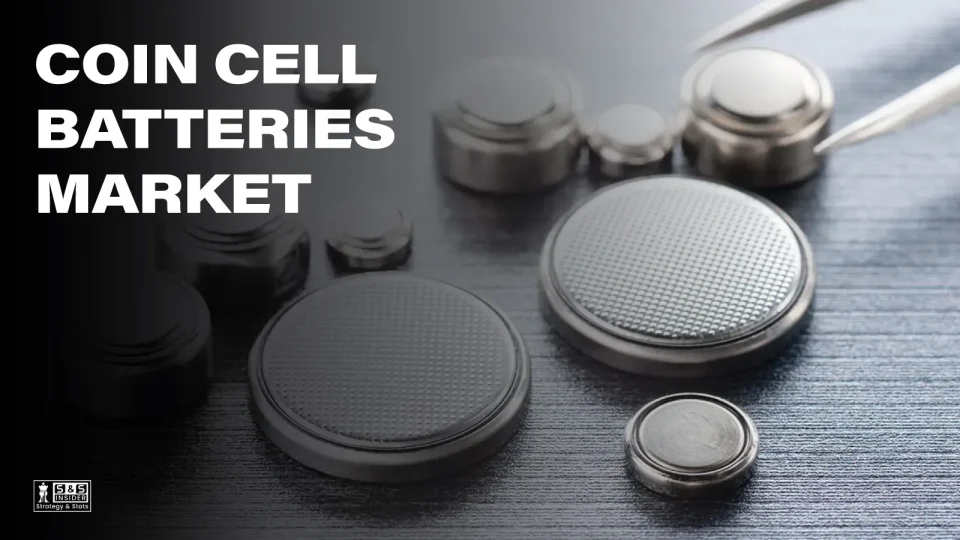
The global coin cell batteries market was valued at USD 4.99 billion in 2024 and is projected to reach USD 7.58 billion by 2032, representing a compound annual growth rate (CAGR) of 5.45% over the 2025–2032 forecast period. Market expansion is driven by rising use of wearable electronics, rapid growth in IoT applications, ongoing advances in lithium battery technology, and growing demand for portable energy solutions in the healthcare sector.
Coin cell batteries are widely used in watches, hearing aids, calculators, medical-device sensors, remote controls, smart wearables, key fobs, wireless sensors and IoT devices. Their small size, light weight, long shelf life, stable voltage, low self-discharge and reliable performance make them a preferred power source for devices that require consistent, long-lasting energy in compact spaces.
Coin cell batteries: Market drivers and forecasts
Innovation in lithium chemistry, increases in energy density, improved thermal stability and longer service life are enabling more complex wearables and medical devices to rely on coin cells. According to industry findings cited in the source, more than 70% of wearable and implantable medical devices are powered by coin cell batteries. Studies referenced in the source also indicate that roughly 70% of sensors launched for IoT applications in 2024 used coin cell or other small batteries because of their low power consumption and stable output.
Coin cell batteries: Leading companies
Panasonic is highlighted for its lithium, alkaline and silver oxide coin cell portfolio, global manufacturing footprint, high-performance battery technologies and strong presence in healthcare and electronics. Murata Manufacturing is noted for its expertise in miniature batteries, high energy-density technologies, a robust IoT and wearable portfolio and advanced manufacturing capabilities. Energizer Holdings is presented as a global consumer brand with a reliable lithium battery lineup and advanced battery safety technologies; in August 2024 the company released an advanced three-layer safety solution that includes a bitter coating, child-resistant packaging and a color alert to reduce accidental ingestion. Sony is described for its high-performance lithium coin cells, long service life, consumer electronics expertise and consistent product quality. The source also lists VARTA AG and EVE Energy among major industry players working on product innovation, production and technology improvements.
Regional outlook
Asia Pacific was the largest revenue contributor to the global coin cell batteries market in 2024, supported by strong electronics manufacturing in China, Japan and South Korea, a high density of battery producers, advanced manufacturing processes, solid supply chains and growing demand for consumer electronics, wearables, automotive electronics and medical devices. China is identified as a dominant manufacturing hub in the region due to manufacturing capacity, lower costs, supportive policies and a large consumer base.
The source states that North America is expected to record the highest growth rate during the forecast period, driven by healthcare advances, wearable adoption and expanded IoT use; it also indicates that more than 60% of coin cell batteries in North America are used in consumer electronics, wearables, remote controls and healthcare equipment. Europe is described as maintaining a strong market presence because of demand from healthcare, automotive and industrial sectors.
Outlook and challenges
Future market developments will be shaped by further advances in battery chemistry, miniaturization, efficiency and intelligent power management as more healthcare products, wearables, implantable medical devices and industrial IoT sensors adopt coin cell power. The source emphasizes that safety, manufacturing sustainability and recycling will grow in importance as competitive differentiators for industry players.
