

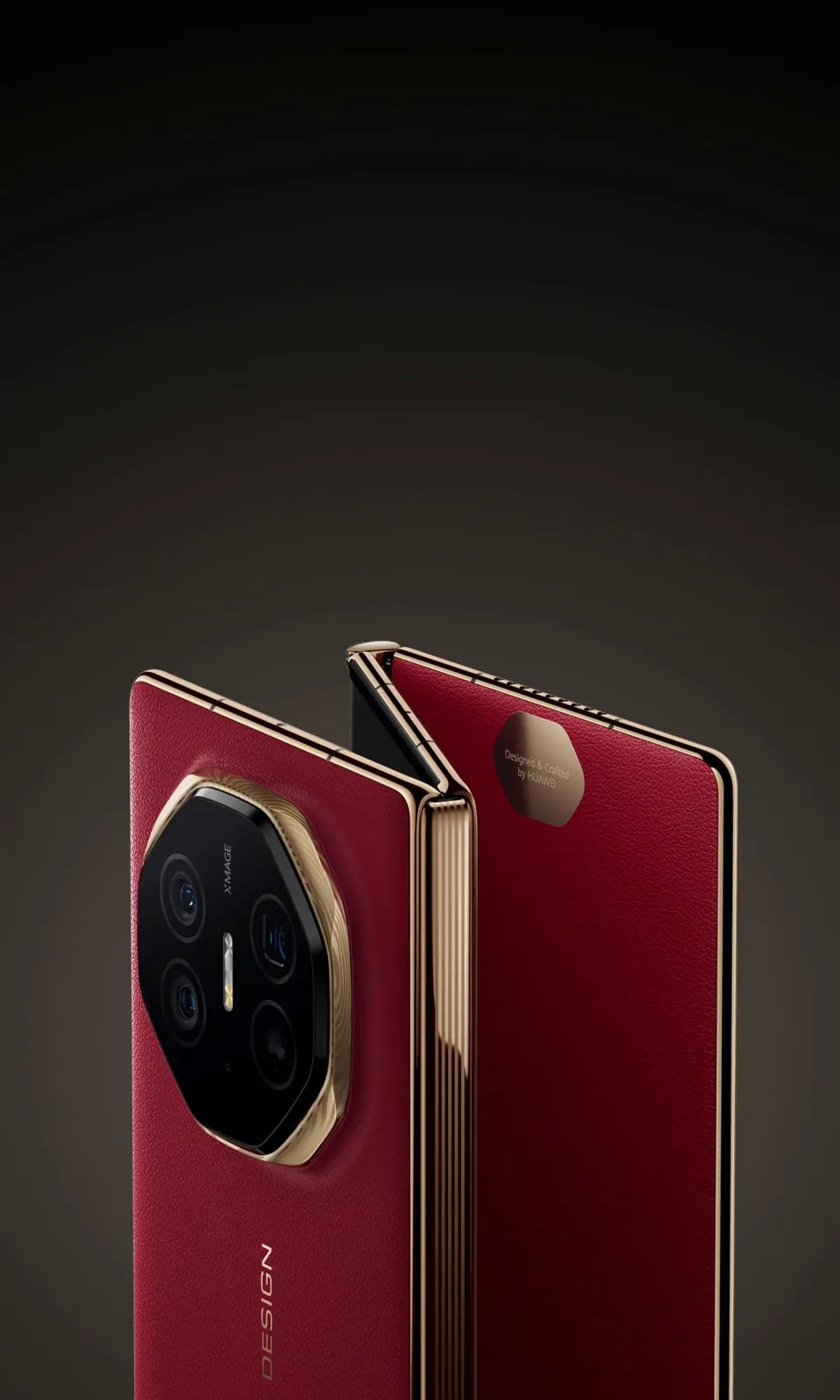
Huawei has revealed its third-generation tri-fold phone, the Mate XT2, and the new model adopts a dual inward-fold design similar to Samsung’s Galaxy Z TriFold, underscoring that Samsung’s approach to tri-fold architecture was correct.
The Mate XT2 differs from Huawei’s earlier tri-folds — the original Mate XT and the Mate XTs — which folded inward on one hinge and outward on the other. Those earlier designs allowed one section of the foldable OLED to remain exposed on the outside when partially folded, leaving the display vulnerable to impact in a drop. By contrast, the Mate XT2’s screen folds inward at both hinges, enclosing the display when the device is closed.
Why the tri-fold inward design matters
Samsung’s Galaxy Z TriFold, launched last year as a technological showcase, already used the dual inward-folding architecture to keep the delicate foldable OLED protected when closed. Huawei’s move to abandon the inward-plus-outward hinge configuration after two generations aligns with that concept and is presented as validation of Samsung’s enclosed design, which the reporting describes as fundamentally safer for long-term durability.
Privacy feature limited to top variants
The Mate XT2 also appears to include a privacy display feature comparable to the one on the Galaxy S26 Ultra. According to the available information, Huawei is restricting this privacy technology to the highest-end variants of the Mate XT2, specifically including the top-tier configuration that offers 16GB of RAM and 2TB of storage.
