

HONG KONG — Cooperation between the United States and China is widely viewed as essential to managing the risks of artificial intelligence as leaders prepare to meet next week in Washington, but the two powers remain wary of each other’s strategies and unlikely to reach deep, verifiable agreements.
The topic of AI governance is expected on the agenda when President Donald Trump meets Chinese leader Xi Jinping. American tech leaders have said averting worst-case scenarios for rogue AI depends on some degree of cooperation with China. At the same time, Trump has warned that efforts to regulate AI could help China, arguing the nation that leads on the technology “wins.” “We are leading China, and all others,” Trump said Monday on social media.
US-China AI strategies and tensions
The United States and China are advancing AI along different paths. U.S. companies are pushing frontier research supported by cutting-edge chips and expanding data center infrastructure, and many leading American models remain closed-source. China is pursuing broad global adoption of open-source, more affordable models.
U.S. restrictions have limited China’s access to the world’s most advanced AI chips, even as Chinese models have made major advances and found users among American companies. At the same time, U.S. Treasury Secretary Scott Bessent said Tuesday the U.S. needs to develop more open-source models to counter China.
Accusations flow both ways: U.S. officials have accused China of “aggressive, malicious” efforts to extract capabilities from American AI systems, while Chinese officials have accused the U.S. of trying to suppress Chinese companies to build a “monopoly of the AI industry.”
David Sacks, a top AI adviser to Trump, said on Fox News’ “The Ingraham Angle” that China has “already rejected” slowing down the pace of developing the most advanced forms of AI and warned of verification problems: “In this case, we don’t have trust and we can’t verify,” he said. “So let’s not be foolish about this and just hand the whole ball game to China.”
Still, some analysts and officials see value in dialogue. Samm Sacks, a senior fellow at the Johns Hopkins School of Advanced International Studies’ Institute for America, China, and the Future of Global Affairs, said: “A formal agreement or consensus may be near impossible, but they do not need to go that far. Trump and Xi just need to create political space by acknowledging AI poses risks to both countries.”
Industry positions and international moves
Leading American AI companies Anthropic and OpenAI restrict access in China and have argued the U.S. has a national security imperative to protect its lead. Yet both have also called for cooperation with China on safety. In an essay urging a slowdown of AI development for safety reasons, Anthropic CEO Dario Amodei said the U.S. should slow China’s progress, including keeping up U.S. restrictions on China’s purchases of the world’s most advanced AI chips, while adding that “global pacing will require cooperation with China, the autocratic country with by far the most advanced AI capabilities.”
Beijing criticized Amodei’s remarks. China’s Ministry of Foreign Affairs said Monday that “fearmongering, confrontation and vicious competition will only disrupt the process of global AI governance which serves no one’s interest.” The state-run Global Times called his remarks “packed with containment provisions targeting China and is, in essence, a ‘Cold War playbook’ for the AI sector.”
Trump has consulted with Nvidia CEO Jensen Huang and even called the chipmaker in the middle of a Monday podcast interview. Nvidia has generally favored some chip exports to China as a way to create an American ecosystem for the technology and a more open relationship on AI.
Both countries have also shown alarm about emerging AI capabilities. The head of China’s Ministry of State Security, Chen Yixin, warned in an article Sunday that AI poses many threats to the country, “from political and ideological security to cyberattacks,” and singled out Anthropic’s and OpenAI’s powerful AI models as potentially exploitable. Separately, a U.S. security firm recently discovered AI-related vulnerabilities in WeChat, according to Paul Triolo, a partner at DGA-Albright Stonebridge Group.
Since a mid-May Beijing summit, when Chinese and U.S. officials said they had agreed to pursue dialogue on AI development and governance, little concrete progress has been reported. Meanwhile, both countries have sought alliances with other nations: in July China launched the World Artificial Intelligence Cooperation Organization with 29 founding member countries including Russia and Pakistan, and Xi has called on BRICS members to accelerate creating a global AI governance framework and to establish an open-source AI community. Some observers view the China-led organization as a response to the U.S.-led Pax Silica initiative, launched last year to strengthen collaboration with partners including Japan, the U.K. and Australia on AI supply chains.
Voices on both sides say cooperation will be difficult but necessary. Asked about expectations for the upcoming Trump-Xi meeting, Amodei said the longer-term goal would be “working together to put a speed limit on the rate of AI progress,” while acknowledging it would likely be very difficult. A Chinese state media-linked social account, Yuyuantantian, said in a recent post that “Only after the United States first demonstrates that the safety rules are equally effective for its own model companies can substantive discussions between the U.S. and China take place.”
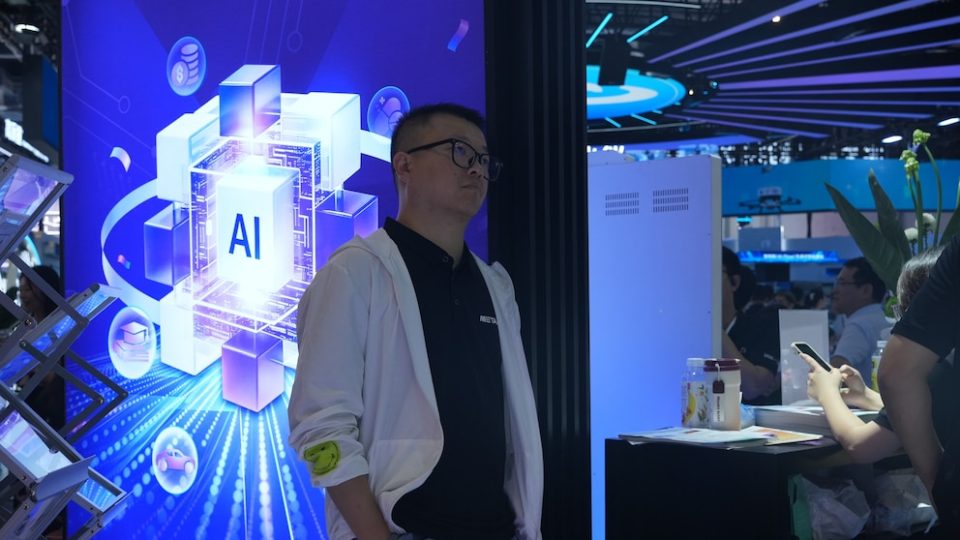
Scenes from the field underscore the technology’s global reach: at the World AI Conference in Shanghai on July 17, 2026, visitors tried Alibaba’s Qwen AI glasses, and booths featured Chinese companies such as Minimax and startup Moonshot showcasing the Kimi K3.
