

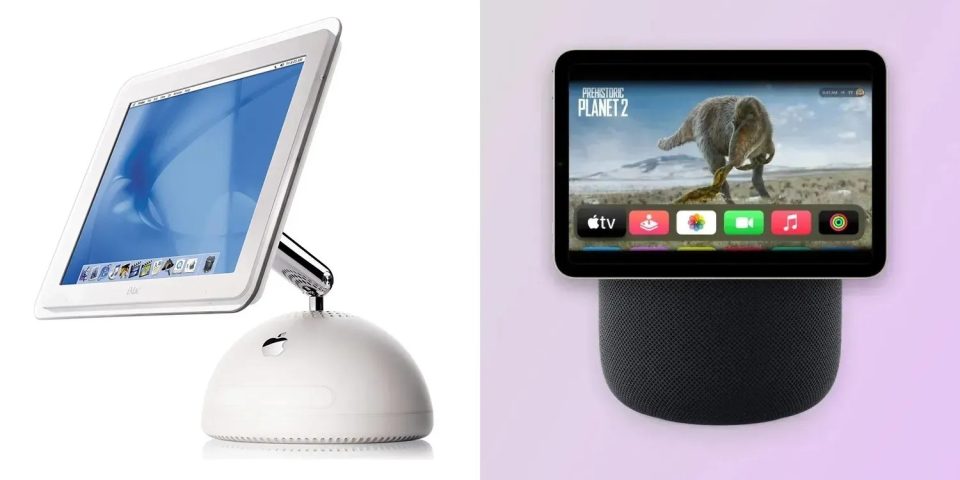
Apple’s long‑rumored smart home hub will feature an iMac G4‑style design and a range of smart‑display features, according to Mark Gurman. The device is described as having a square 6‑inch display available in two variants: a countertop model and a wall‑mounted version.
Design and hardware of the Apple smart home hub
The hub’s display is said to be about as thick as an iPhone, surrounded by a quarter‑inch black bezel with rounded corners and no sharp edges. It uses a single FaceTime camera on the front, while microphones and speakers are located in a connected base. The standard countertop model features a metal, round base with multiple rings of perforated speaker holes, a polished metal arm connecting the screen to the base, and a rubberized bottom to keep it steady on a table. Users can manually tilt the display forward or backward.
The device lacks a battery and must remain plugged in at all times; there are no volume or power buttons. It comes in Apple’s standard gray aluminum finish and includes a USB‑C port for power. Apple has also developed a second variant, codenamed J491, designed for wall mounting. That version has a thin, square‑shaped base beneath the display that houses speakers and microphones and sits flat on the wall below the screen; it, too, requires a USB‑C power connection.
Interface, personalization and identification
Apple intends the hub to be placed in multiple rooms to control smart home devices, make video calls and intercom‑style messages, play audio, and display photo slideshows. The device will serve as an information hub in the kitchen, with the ability to watch videos and look up recipes using voice commands.
The hub will recognize who is speaking or approaching and display personalized content and answers accordingly; the interface will change automatically depending on who is using the device. A visitor mode will hide personal information. Identification will rely on voice or facial recognition, with facial recognition described as less reliable than Face ID. Users can enable a secondary authentication method via an iPhone, and the iPhone will act as a fallback when the hub cannot identify someone. In dark rooms, a Mac‑style Edge Light will illuminate the area around the screen to assist the camera.
Software, apps and user experience
The user interface is reported to blend elements of Apple Watch, Apple TV and iPad, while Siri AI retains the dark visual style used on other Apple devices. iPhone‑style widgets will be available, and users can choose a wallpaper and rearrange apps and widgets by pressing and holding them. The UI is said to be heavily built around slideshows and clock displays, similar to the revamped StandBy Mode on the iPhone Duo; one clock is described as resembling “a lava lamp with an overlay of the time that shows the hour in digital form with minutes listed below.” Users can swipe up from the clock screen or photos to open the app launcher.
The device will include many of Apple’s commonly used apps, including Calendar, Messages, Photos, FaceTime, Notes, Reminders, Music and Podcasts. The Home Screen will feature Apple Watch‑style apps that open into iPad‑style interfaces with multiple panels—for example, Messages is said to use a two‑panel layout like on the iPad, with a conversation list and a separate pane for the message feed.
The hub is reportedly set to be introduced on Tuesday, October 13, alongside new HomePod mini and Apple TV models.
