

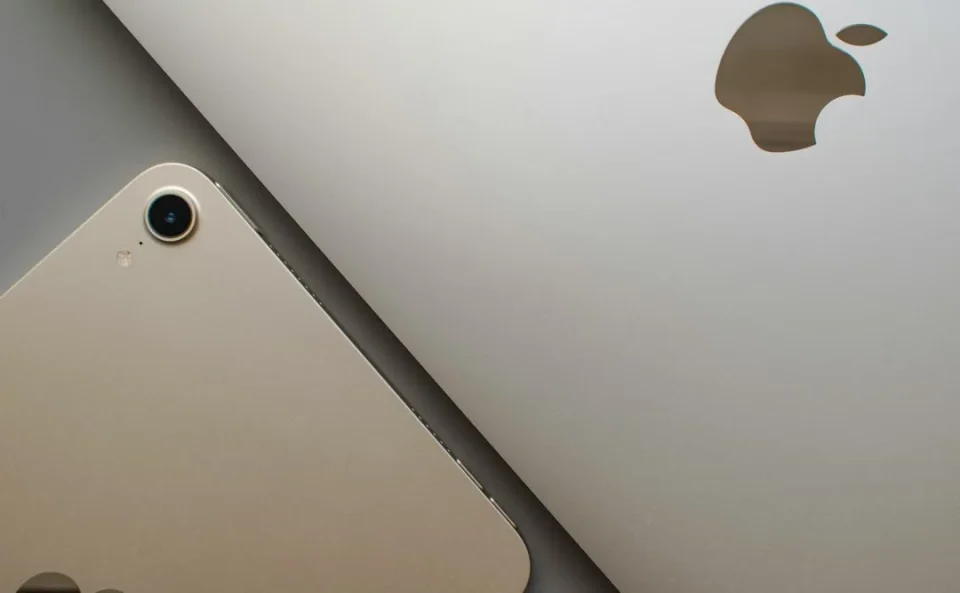
Apple today announced the eighth-generation iPad mini, featuring a larger OLED display, a thinner and lighter design, the A20 Pro chip, and water and dust resistance; the new model starts at $699 for the 128GB Wi‑Fi version and $849 with cellular, while the prior A17 Pro generation is now discontinued.
iPad mini: Major hardware and display changes
The 2026 iPad mini moves from an 8.3‑inch Liquid Retina LED IPS display to an 8.5‑inch Super Retina XDR OLED panel with a 1‑nit minimum brightness, a 2,000,000:1 contrast ratio and a 2316-by-1512 resolution, compared with the 2024 model’s 2266-by-1488 resolution. Display borders are 24% thinner on the new model, and peak brightness improves from 500 nits to 600 nits for SDR and full-screen HDR with 1,200 nits peak HDR brightness. Optional nano-texture display glass is available on the 256GB and 512GB A20 Pro models for an additional $100 and is supplied with a polishing cloth.
The new model replaces landscape front-camera placement with a Center Stage front camera using an f/2.0 aperture, up from the prior model’s portrait front camera and f/2.4 aperture. Rear flash moves from True Tone to Adaptive True Tone. Stereo audio also changes: the 2024 model used landscape stereo speakers with external holes, while the 2026 model uses an Acoustic Display with display-coupled woofers and concealed tweeters without external speaker holes.
Performance: A17 Pro versus A20 Pro
Apple says the A20 Pro is built on a 2‑nanometer process versus the A17 Pro’s 3‑nanometer process, and that the new chip delivers up to 60% faster multithreaded CPU performance, up to 2.7x faster graphics, and up to 4.5x faster AI performance compared with the A17 Pro. GPU cores increase from 5 to 7.
Unlike the A17 Pro, the A20 Pro’s CPU and Neural Engine configurations vary by storage: A17 Pro used a six-core CPU with two performance and four efficiency cores and 16‑core Neural Engine and 8GB unified memory. The A20 Pro uses a 5‑core CPU (2 super cores, 3 efficiency) for 128GB and 256GB models and a 6‑core CPU for the 512GB model; the Neural Engine is 16 cores on 128GB and 256GB models and dual 16‑core units (32 cores total) on the 512GB model. Apple notes increased unified memory capacity for the A20 Pro but has not specified exact amounts; unified memory bandwidth rises from 51.2 GB/s to 115.2 GB/s.
Connectivity, battery and sensors
Wireless hardware is upgraded: the 2026 model uses Apple N1 wireless networking, adds Wi‑Fi 7, Bluetooth 6 and Thread, and swaps the previous third‑party wireless module. Cellular models move from a Qualcomm Snapdragon X70 5G modem to an Apple C2 5G modem, which Apple says can deliver up to 50% faster cellular data speeds; U.S. model numbers change from A2995 (2024) to A3596 (2026) with different band support (2026 listed as supporting LTE band 106). The 2024 model listed UMTS/HSPA/HSPA+/DC‑HSDPA support, while the 2026 listing shows UMTS/HSPA/HSPA+ support.
Battery capacity changes from 19.3Wh in the 2024 model to 18.9Wh in the 2026 model, and Apple advertises the same battery life for both. The 2026 iPad mini supports fast charging up to 50% in around 30 minutes with a 35W or higher USB‑C power adapter.
Design, dimensions and accessories
The new iPad mini is roughly 14% thinner (0.21 inch / 5.4 mm versus 0.25 inch / 6.3 mm) and lighter: the Wi‑Fi model drops from 293 grams to 255 grams and the cellular model from 297 grams to 263 grams (approximately 13% and 11% lighter, respectively). Width changes from 134.8 mm to 132.6 mm while height remains essentially unchanged.
Apple replaced the previous polyurethane Smart Folio with a redesigned two-panel TechWoven Smart Folio offering adjustable viewing angles; it is sold separately in Navy Blue and Taupe for $79. The overall recycled content increases from more than 25% to 35%.
Pricing, storage and buying advice
The 2026 iPad mini starts at $699 for the 128GB Wi‑Fi model and $849 with cellular. The prior generation originally launched at $499 (Wi‑Fi) or $649 (Wi‑Fi + Cellular) and later saw its Wi‑Fi starting price rise to $599 before being discontinued. Both models offer the same storage capacities, advertised battery life, Touch ID authentication and USB‑C transfer speeds.
Most owners of the A17 Pro iPad mini can reasonably keep their devices: the new model does not improve every aspect of the experience. The larger OLED display and the thinner, lighter chassis are the clearest reasons to upgrade, especially for users who watch videos or read extensively. Nano-texture glass is a specific upgrade for those who dislike reflections, but it requires at least the 256GB A20 Pro model plus the $100 option.
Landscape camera placement, IP67 water and dust resistance, and faster charging are useful additions but are unlikely to justify replacing an A17 Pro iPad mini on their own. An upgrade becomes more sensible when several of the new features address limitations of your current device.
For new buyers, the A20 Pro iPad mini is the recommended starting point for its OLED display and redesigned body. The A17 Pro model remains a sensible option if it offers substantial savings, since it retains many capabilities for reading, browsing, note taking and video playback. Note that the A20 Pro’s 256GB model is required for nano-texture glass and the 512GB model adds an extra CPU core and a second Neural Engine.
