

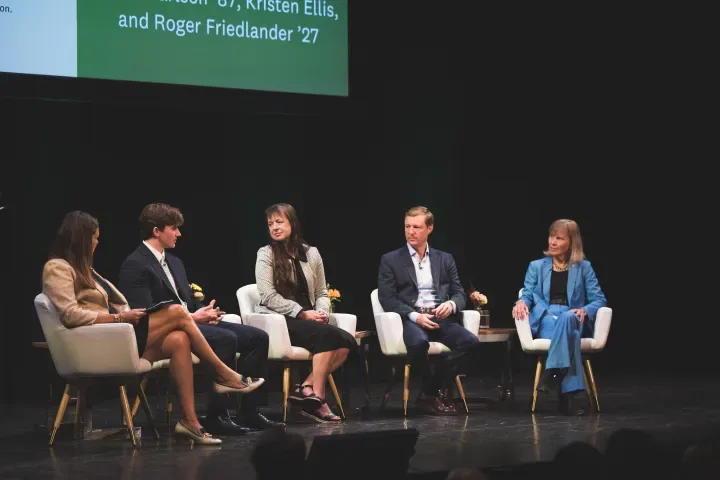
At the fourth annual Dartmouth AI Conference on Oct. 16 at the Computer History Museum in Mountain View, speakers across industries focused on how to deploy AI in business, when human judgment remains essential, how to regulate fast-moving technology and who should be held accountable when AI causes harm.
AI, human judgment and regulation
The event, led by Tuck’s Center for Digital Strategies and timed to coincide with the anniversary of the 1956 Dartmouth summer study that coined the term “artificial intelligence,” emphasized practical application over theory. Sessions ranged from “Power, Compute, and Concrete” to “AI in the Physical World,” and most featured executives and practitioners sharing real-world deployment experiences.
Opening the conference, Alva Taylor, senior associate dean and the center’s faculty director, stressed the continuing value of people in AI systems: “We have abundant intelligence. The scarce resource as intelligence gets easier is human judgment.” Taylor also moderated a panel on AI companions.
Patrick Wheeler, executive director of the Glassmeyer/McNamee Center for Digital Strategies, said the sector has shifted rapidly since last year: “The sector has changed dramatically since last fall’s conference—we’ve seen agentic AI emerge alongside new risks, such as worldwide cybersecurity challenges.” He added that “Human judgment was a core theme of this year’s conference,” noting speakers addressed when to use AI and how to preserve critical thinking as models become more capable.
Panelists agreed on the need for thoughtful regulation, discussing child safety, legal responsibility when AI causes harm, and how U.S. rules could affect international competition in AI.
Real-world deployment and the role of human reviewers
A fireside chat with Bradley Webb T’16, chief operating officer of Surge AI, highlighted the continuing demand for human expertise in AI workflows. Surge AI helps developers improve models by having experts review and correct AI output. Webb said, “The biggest challenge and the biggest change [with AI] is that the models are more capable, and that increases the length of time that a model can exert some human level of judgment.” He warned that as models solve more complex problems, demand for human reviewers who can evaluate performance and provide feedback is rising and becoming a bottleneck in AI development and research.
A separate panel on how AI is reshaping business and work featured Carl Shan of OpenAI and Doug Tallmadge D’19, co-founder of Gradial, with Warren Valdmanis D’95 of Future of Work Partners moderating. Shan noted AI’s ability to complete complex coding tasks, but observed that “job postings for software engineers have gone up in 2026 compared to 2025.” He asked, “Why is that? Even if you can automate a lot of these tasks?” and answered: “The short answer that I would give is—a job is a lot more than a bunch of tasks. Tasks are part of it, but a huge part of it is accountability, responsibility, and ownership.”
Sandy Chen Fedor T’15 of General Motors and Gemma Ross D’08 of OSARO also discussed real-world AI applications during a panel on AI in the workplace.
AI companions, loneliness and ethical limits
Taylor’s panel on AI companions included Karen L. Fortuna, associate professor at Geisel School of Medicine at Dartmouth; Nicole Lopez, a partner at Orrick; and Dr. Sarah Shirazyan, a lecturer at Stanford Law. Panelists agreed AI companions can help address loneliness and information access for populations from older adults with chronic illness to teens, but should not replace human relationships.
Fortuna said loneliness is a major driver of interaction with AI companions and noted a service gap after work hours following Medicaid cuts: “Loneliness is just as deadly as smoking a pack of cigarettes a day, and what we’re finding with our technology within the older adult population is that people are using this at 3:00 a.m. when people aren’t available to them.”
Infrastructure, hardware and students applying AI
Panels on infrastructure and AI in the physical world drew interest from attendees who wanted concrete examples of AI in action. Amos Cariati D’18, T’27, a second-year MBA student and Center for Digital Strategies Fellow, said he appreciated the focus on hardware and tangible applications beyond software: “So much of the discourse is around software,” he said. “I really like that interplay with the physical world.”
Cariati described a conversation with David Picotte T’11, an infrastructure expert and senior vice president at Vertiv, about efforts to make data centers more efficient, including closed-loop cooling systems to better manage heat from servers and networking equipment. Cariati said it was encouraging to hear builders are aware of energy and water costs and seek greener infrastructure to lower electricity expenses.
Cariati used AI extensively for his entrepreneurial First-Year Project, applying it from back-end app development to market research and note-taking. After graduation he will join Procter & Gamble’s brand management team and plans to bring AI into his work: “I view my ability to leverage these tools as something that will differentiate me. My goal from attending this conference and remaining involved in this space is to understand what’s possible so that I can put the knowledge to use if the right opportunity arises.”
More information on the conference is available here.
