

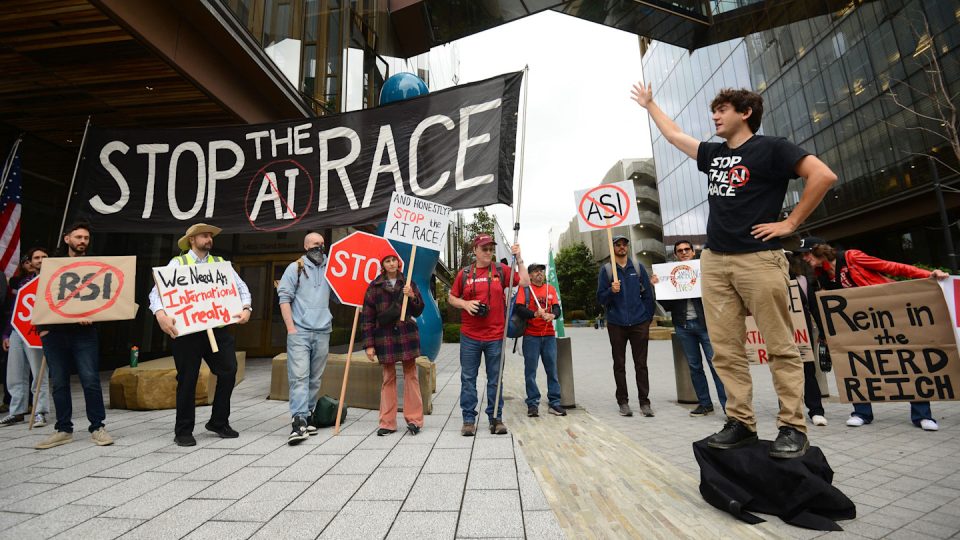
State governments are moving to regulate artificial intelligence now, and Massachusetts appears poised to be a leader in AI regulation. Policymakers increasingly point to the nuclear nonproliferation treaty as a model of international cooperation against existential threats, but note that treaty addressed a simpler problem — with only governments controlling stockpiles — and took decades to achieve, time advocates say the country cannot afford with AI.
State Senator Barry Finegold, who is helping lead Beacon Hill’s push for new rules, said, “I actually do believe that this should be done at the federal level,” and added, “But if the federal government does not pass anything, then states like ours are going to do stuff.”
As part of an economic development bill moving through the Legislature, the Senate introduced rules to regulate companies that generate more than $500 million in annual AI-derived revenue. The legislation calls for a transparency framework — essentially a safety plan — and third-party auditors to ensure compliance. “Independent verification organizations” would also be established to evaluate potential catastrophic risks from AI, amounting to what the bill describes as a second set of eyes.
The nonprofit Fathom supports the stringent review process proposed in Massachusetts. Fathom CEO Andrew Freedman told the editorial board that Massachusetts, with its concentration of universities, could create jobs and grow AI-oversight expertise. “This is a real science, this isn’t check-the-box compliance,” he said, and added that government must define what constitutes independent oversight expertise: “Somebody needs to be verifying the verifiers.”
Many, but not all, of the tech behemoths are pushing back against oversight in Massachusetts and other states, using deep-pocketed lobbying efforts to stop legislation.
Over-regulation is rarely ideal, the editorial argues, but history shows many industries have tried to evade outside oversight while few have effectively self-regulated. With trillions of dollars at stake, the piece says it is unrealistic to expect tech companies to voluntarily open their doors or police themselves.
Finegold likened the need for AI rules to safety requirements placed on cars decades ago, noting that auto companies once resisted seat belts because their inclusion could suggest cars were unsafe. “Every generation faces new technology, and every generation must decide how to use it safely,” he said. “As we talk about cars, we didn’t ban them, we just made them safer.”
The editorial urges that AI regulation not be written only by elected officials and tech workers. Educators, artists, writers and many other professions “should have a seat at the table,” it says. It adds that “Devising regulation to prevent AI systems from destroying humanity is a comically low bar. We need AI regulations that align with human values so the technology doesn’t continue to tear at the fabric of society.”
AI regulation spreads beyond Massachusetts
California, home to many major AI companies, has also stepped forward. Last year the California Legislature enacted a law requiring AI companies to report safety protocols, and the state “added more teeth to the framework this fall.” Governor Gavin Newsom signed an executive order that includes the possibility of embedding independent representatives into AI companies. New York, Illinois and Virginia have also passed bills requiring more AI transparency and safety measures.
Juniper Katz, an assistant professor of public policy at the University of Massachusetts, noted California’s outsized role on issues like climate policy: “If we imagine the role that California, for example, has played in climate policy, it’s been pretty significant. California is such a big state that when they implement things, it kind of affects everybody,” she said. “Could states do that for AI? I don’t know.”
The editorial acknowledges that a patchwork of state laws is not ideal, but says that as more legislatures grapple with AI legislation, a quasi-national standard could emerge. “In the absence of meaningful reform from Washington, for now, that seems to be the best path forward.”
