

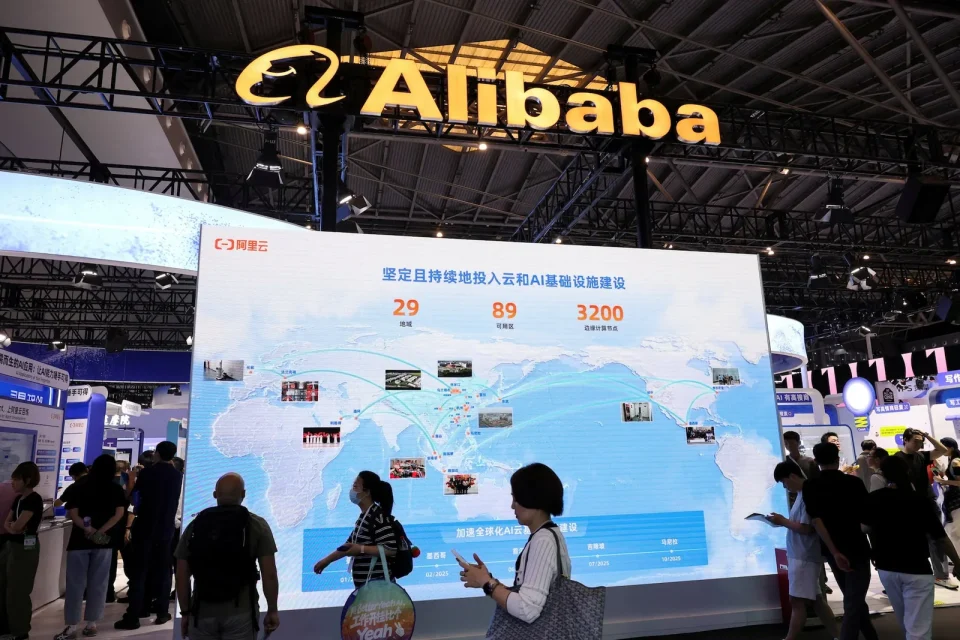
Alibaba on Tuesday unveiled new artificial intelligence chip technologies and plans for larger AI models, including what it said was “China’s most powerful AI chip,” days ahead of high-level talks between Chinese and U.S. leaders where AI competition is expected to feature prominently.
Alibaba’s AI chip and model plans
Alibaba’s CEO Eddie Wu announced the Zhenwu V900 chip at the company’s flagship conference in Hangzhou, saying the V900 is “the most powerful AI chip in China today” and can deliver three times the performance of the company’s previous-generation Zhenwu M890 chip. Alibaba said its Zhenwu chips power frontier AI model training and “inference”—the calculations a trained AI uses to deliver responses—and are deployed in its data centers to serve the company and its cloud clients.
The company also outlined plans to train a new AI model at a scale of five to 10 trillion parameters, a measure of an AI’s learning capacity, moving closer to the scale of the most advanced U.S. models. Alibaba’s most powerful Qwen series model to date, Qwen3.8-Max, has 2.4 trillion parameters. The Chinese AI company Moonshot’s Kimi K3, released in July, is cited by Moonshot as the world’s largest open model with 2.8 trillion parameters.
Scaling compute and infrastructure
Alibaba said it plans to expand the data centers that underpin its cloud computing business to meet “exponentially” rising demand for AI computing and expects to have over 20 gigawatts’ worth of computing by 2032. CEO Wu said the company is “mobilizing every resource” to meet customers’ demand for AI and warned that “global shortages across the AI data center supply chain” are currently limiting how quickly it can scale compute infrastructure.
For comparison, SpaceX reported approximately 1.4 gigawatts of AI computing capacity as of mid‑this year and said it aims to reach over 10 gigawatts in 2027.
Wu also likened AI growth to the industrial revolution, saying “machine intelligence today is not a substitute for human intelligence,” and predicting that eventually machines will be able to produce over 1,000 times more “thinking” than all of humanity combined, up from less than 3% currently.
Geopolitical and industry context
Alibaba’s announcement arrives as U.S. AI figures, including Anthropic CEO Dario Amodei, warn that China’s AI development poses a threat to the United States and call for an overall slowdown in AI development. Chinese leader Xi Jinping is set to arrive in Washington on Wednesday for a state visit and a meeting with U.S. President Donald Trump, at which AI, trade and tariffs are expected to be discussed.
The company noted broader Chinese momentum in AI chip and model development: Huawei last week unveiled new chip technologies as it seeks to challenge global leaders such as Nvidia. Analysts have said frontier AI training in China often relies on Nvidia chips, though Chinese-designed chips are gaining ground amid U.S.-led export restrictions that have barred China from accessing some of the world’s most cutting-edge AI chips and chipmaking machines.
“Using extra computing power to make up for chip limits helps China stay strong locally,” said Neil Shah, vice president of Counterpoint Research. Counterpoint senior analyst Parv Sharma added that how much the AI and chipmaking gap between China and the U.S. narrows will also depend on other factors, including China’s ability to advance chip foundries that manufacture chips, not just chip design capabilities.
