

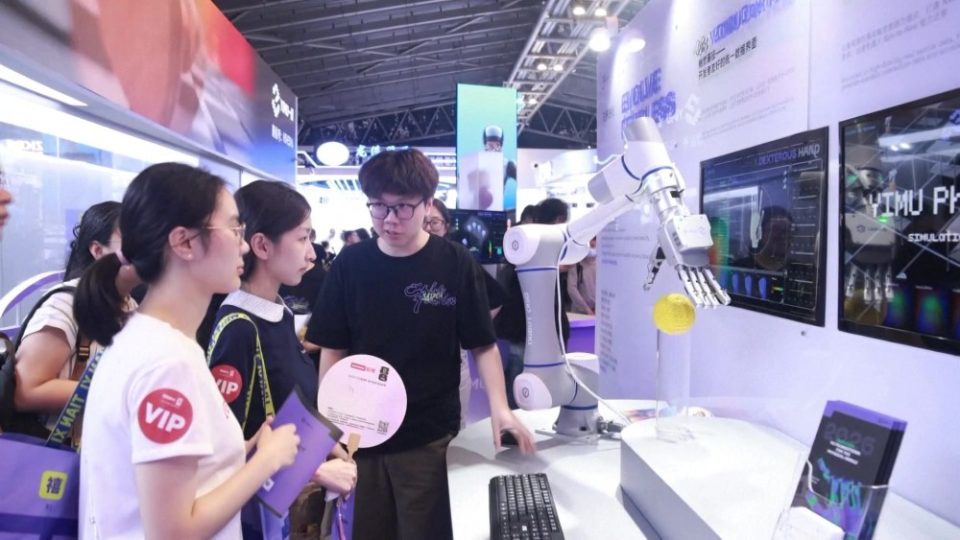
At the World AI Conference 2026 and the High-Level Meeting on Global AI Governance in Shanghai (July 17–20), humanoid-equipped sensors took center stage, highlighting advances in embodied intelligence. Key demonstrations included robots designed for both industrial and domestic tasks and a flexible electronic-skin tactile glove meant to be worn by humans to help robots perceive the world.
Humanoid sensors: prototypes and use cases
Exhibition booths showcased sensor systems that aim to reproduce human vision and touch. Alongside visual and tactile sensors integrated into robot platforms, the event featured wearable devices — notably the electronic-skin glove — engineered to transmit sensory data to machines. Demonstrations ranged from fine manipulation to more natural human-facing interactions.
Toward more “embodied” intelligence
The showcased innovations reflect a clear push to give machines perception closer to human experience, reinforcing the concept of embodied intelligence. Organizers and exhibitors emphasized how humanoid sensors can improve robots’ responsiveness and adaptability, while providing no new commercial timelines or additional quantified performance metrics.
A rapidly scaling Chinese market
Presentations at the conference highlighted the industrial scale behind these advances: Chinese production of humanoid robots is expected to exceed 100,000 units this year, a figure cited by speakers that underscores growing manufacturing volume alongside sensor improvements and practical demos.
Rethinking human–machine interaction
The flexible electronic-skin tactile glove — presented as a human-worn interface to help robots “feel” — illustrates an approach where humanoid sensors extend beyond robot bodies to form a sensory bridge between people and machines. Presenters stressed the complementarity of embedded sensors and wearable interfaces in enriching robotic perception.
Outlook and significance
The Shanghai demonstrations point to accelerating efforts to align robotic perception with human sensory experience across industrial and everyday contexts. While no immediate deployment plans were announced, the event marked a notable step in the maturation of sensory technologies for robotics.
Closing
As the World AI Conference 2026 concluded, it revealed an ecosystem where humanoid sensors, wearable interfaces and rising production volumes are converging, charting a course toward more sensitive, adaptive interactions between robots and people.
