

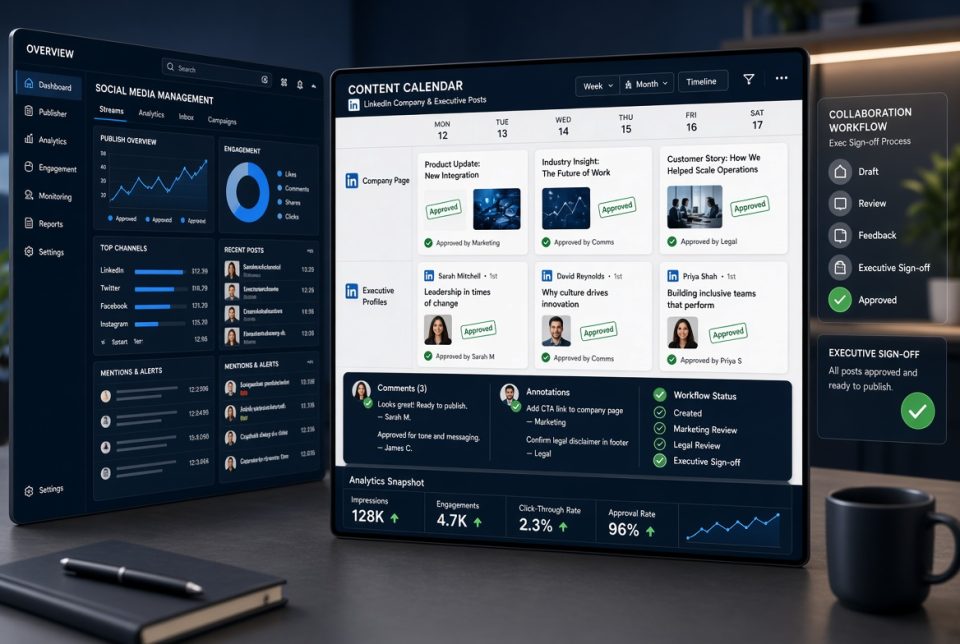
If your B2B SaaS team is leaving Hootsuite, the best Hootsuite alternative to move to is Planable, a social media management tool built around the approval workflows and LinkedIn coverage that committee-driven B2B social runs on. B2B social is different: many teams are lean, in-house, and LinkedIn-first, selling into buying committees over long cycles, and they often question what per-seat dollars buy.
Three reasons B2B teams look beyond Hootsuite explain the shift. First, cost: Hootsuite Standard starts at $99 per user per month and every extra seat pays the full rate, while marketing budgets are flat at 7.7% of company revenue. Second, approvals: B2B publishing often routes through executives and advocacy contributors, and Hootsuite’s approval layers sit in higher tiers rather than being built for exec sign-off. Third, feature tilt: much of Hootsuite’s breadth targets consumer social where reach is not the constraint—Meta’s apps alone reach 3.48 billion daily active people—so fit matters more than raw network size.
Hootsuite alternative comparison matrix
Ranked for the B2B job these tools are evaluated on, the seven options below summarize LinkedIn support, approvals, analytics, best-fit use and listed price points.
1. Planable
Best for: LinkedIn-first B2B SaaS teams that need executive and advocacy posts signed off before publishing.
Standout: Supports LinkedIn Company Pages and Personal Profiles in one workspace, four content views, real-time comments, annotations and text suggestions to shape drafts without multiple documents.
vs Hootsuite: Hootsuite wins on integration breadth, native social listening and enterprise governance (SSO, dedicated support). Planable trades broader surface area for tighter fit: approval workflows built for exec and advocacy sign-off and a calendar designed to be forwarded by a program champion.
Pros: Company Pages and Personal Profiles in one workspace; approval workflows (none, optional, required on Pro; multi-level on Enterprise); analytics add-on covers paid and organic in one view.
Cons: Analytics is a paid add-on, not bundled; no white-label reporting; multi-level approvals are Enterprise-only.
Pricing: From $33/workspace/mo billed annually ($39 month-to-month); analytics add-on $14/ws/mo covering paid and organic.
Scoreboard: One calendar for company and executive posts, with paid and organic analytics reading from one sheet; a fit that favors lean teams proving social’s contribution to buying committees.
2. Sprout Social
Best for: teams whose scorecards rely on reporting depth and social listening.
Standout: Best-in-class reporting and listening that surface category conversations many tools miss; share of voice and engagement quality come out of the box.
vs Hootsuite: These two compete at the top of the market. Hootsuite still edges Sprout on integration breadth and network-scale ads management and often undercuts on price. Sprout answers with a cleaner interface and deeper native reporting.
Pros: Best-in-class analytics and reporting; strong engagement inbox; solid listening at higher tiers.
Cons: Expensive per seat; many features gated to top tiers.
Pricing: Essentials $79/seat/mo (billed annually); Standard $199/seat/mo; 30-day trial.
Scoreboard: Delivers enterprise-grade reporting for the brand half; directional on pipeline contribution.
3. Buffer
Best for: small B2B teams that want clean scheduling without a heavy platform.
Standout: Easy to learn and cheap to run; a clean queue and low per-channel cost suit two-person teams posting a handful of LinkedIn updates per week.
vs Hootsuite: Hootsuite wins on depth—mature listening, broader integrations and enterprise governance. Buffer wins on simplicity and price and keeps a free plan Hootsuite dropped in 2023.
Pros: Very low entry cost; easy to learn; free plan available.
Cons: Per-channel pricing can add up; light on analytics, listening and deep approvals.
Pricing: Free plan; Essentials $5/channel/mo, Team $10/channel/mo with unlimited users, billed annually.
Scoreboard: Covers the brand half at its simplest; likely to be outgrown when committee-grade sign-off is needed.
4. Agorapulse
Best for: teams fielding heavy inbound where comments, DMs and social-assist moments run through a shared inbox.
Standout: Unified inbox with assignment features that prevent dropped conversations; valuable where a single reply can start a sales-assist moment.
vs Hootsuite: Hootsuite offers wider network range and deeper enterprise listening and ads management. Agorapulse counters with a cleaner inbox and more approachable ROI reporting for mid-market teams.
Pros: Excellent unified inbox; strong collaboration and assignments; solid ROI reporting.
Cons: Per-user pricing; profile caps on standard tiers can force upgrades.
Pricing: Standard $79/user/mo (billed annually); 30-day trial.
Scoreboard: If pipeline contribution comes from conversations, Agorapulse supplies the queue to catch them.
5. CoSchedule
Best for: content-led B2B teams that want social inside a broader marketing calendar.
Standout: Treats social as part of a wider editorial operation so blog, email and social share one timeline.
vs Hootsuite: Hootsuite is the deeper pure-play social tool with stronger native publishing, listening and inbox. CoSchedule wins on cross-marketing planning and content ops visibility.
Pros: Strong cross-marketing editorial calendar; good for content operations; approachable entry price.
Cons: Social-publishing depth trails dedicated tools; X profiles billed separately.
Pricing: Social Calendar $19/user/mo (billed annually; $29 month-to-month); X profiles billed separately, around $16/profile/mo.
Scoreboard: Keeps the editorial engine visible where content marketing drives the program; not designed to deepen brand-half analytics.
6. SocialPilot
Best for: teams managing many profiles on a tight budget that still want approvals and bulk scheduling.
Standout: Price-to-feature ratio: bulk scheduling, client management and approvals at a fraction of premium pricing.
vs Hootsuite: Hootsuite offers deeper analytics, more mature listening and broader integrations. SocialPilot does not match that depth and instead wins on cost and multi-account coverage.
Pros: Strong price-to-feature ratio; bulk scheduling and approvals; handles many accounts affordably.
Cons: Analytics and listening are less deep than premium tools; utilitarian interface.
Pricing: Standard $34/mo (billed annually); Premium $85/mo; 14-day trial.
Scoreboard: Keeps many-account programs running cheaply; brand-half metrics remain basic.
7. Sendible
Best for: teams and agencies that want unlimited users without per-seat fees.
Standout: Unlimited users on every plan, changing the cost math for growing teams; supports routing posts through approval flows.
vs Hootsuite: Hootsuite brings deeper native listening, a larger integration ecosystem and stronger enterprise governance. Sendible answers with unlimited seats and white-label reporting Hootsuite charges a premium to approach.
Pros: Unlimited users on every plan; white-label reports and dashboards; good for many client accounts.
Cons: Interface feels dated to some; profile caps per tier.
Pricing: Core $29/mo with unlimited users; 14-day trial.
Scoreboard: When headcount is the cost driver, Sendible lets the whole committee into the tool without per-seat penalties.
How to choose the right Hootsuite alternative for your B2B program
There is no single winner—pick the tool that matches the job. Use your social collaboration workflow as the test: what does the program champion forward, and who must sign off before publishing?
– LinkedIn-first with executive and advocacy sign-off: Planable (company and personal profiles in one calendar, approvals built for committee publishing).
– Deep analytics and listening: Sprout Social, if budget allows.
– Simple and cheap to start: Buffer.
– Heavy inbound and engagement: Agorapulse.
– Content and editorial operations: CoSchedule.
– Many accounts on a budget: SocialPilot or Sendible, with Sendible favored when headcount, not profiles, drives cost.
FAQ
What’s the best Hootsuite alternative for B2B SaaS teams?
Planable, for most lean, LinkedIn-first B2B teams. It covers LinkedIn Company Pages and Personal Profiles in one calendar, builds approvals around exec and advocacy sign-off, and reports paid and organic together through its analytics add-on. Sprout suits teams that need premium listening; Buffer fits those wanting the simplest, cheapest start.
Which tool handles LinkedIn company and personal profiles?
Planable supports both LinkedIn Company Pages and Personal Profiles in the same workspace so brand posts and executive posts share one calendar and one approval flow.
Can you get approvals on executive and advocacy posts?
Yes. Planable offers none, optional, required approvals on Pro, and multi-level sequential approvals on Enterprise so a post can route from contributor to legal to executive before publishing.
Do these tools help prove social’s pipeline contribution?
Partly. They build the brand half of the scoreboard—engagement quality, share of voice, paid and organic analytics. The pipeline half lives in your CRM, where sales-assist moments and influenced deals are documented; label them directional, not attributed.
B2B social is a different sport. Choose the Hootsuite alternative that scores the way your committee buys.
