

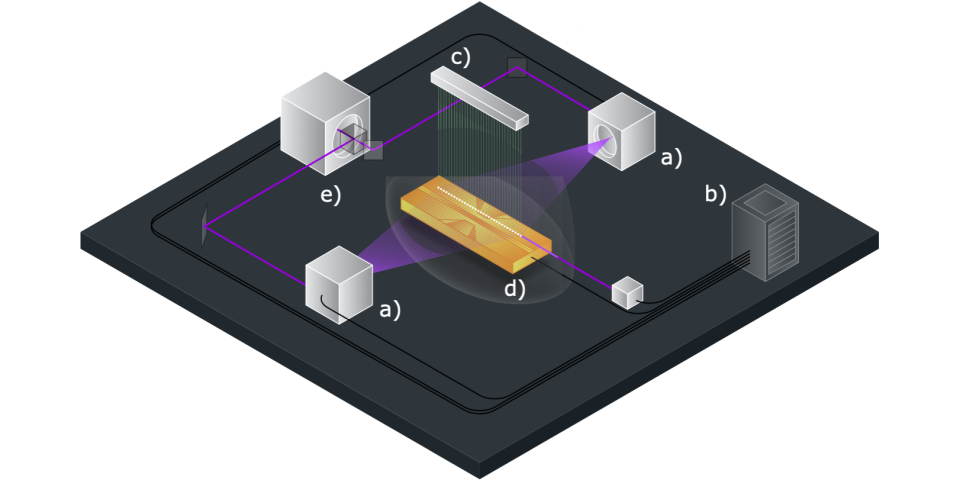
ZuriQ has announced a $25.5 million funding round to accelerate production of its two-dimensional trapped‑ion quantum computing architecture, backed by an industrial partnership with Infineon Technologies. Spun out of research at ETH Zürich, the startup aims to turn proofs of concept into ion chips that are compatible with standard CMOS fabrication lines.
A round to scale
The seed round, led by Quantonation and joined by Forward.one, Extantia, Firgun Ventures and early backers, follows a $4.2 million pre‑seed raise in 2025. Proceeds will be used primarily to bolster R&D, increase manufacturing throughput with Infineon, and expand a technical team of 18 people that has already been strengthened by hires from IonQ, Xanadu and Hamamatsu.
Micro‑Penning: an alternative to Paul traps
ZuriQ’s platform centers on micro‑Penning traps, which replace the high‑frequency RF electric fields used in Paul traps with static magnetic and electric fields. This approach lets ions move freely in two and three dimensions and avoids the complex physical junctions required by conventional 1D chain architectures. According to the company, qubit density therefore scales with chip surface area rather than with the length of an ion chain—opening the door to a scaling regime that grows with the chip’s area.
Designed for industrial production
The Infineon partnership is intended to leverage semiconductor fabs to produce ion chips at scale. Because the micro‑Penning architecture avoids high‑voltage, high‑frequency RF signals, it reduces substrate heating and simplifies integration into standard CMOS processes—an essential step for migrating from academic labs to reproducible, industrially manufactured chips. Infineon contributes years of chip‑manufacturing expertise to the collaboration.
3×3 demonstrator and technical roadmap
ZuriQ has validated the approach with a functional nine‑ion 3×3 demonstrator—presented as the largest 2D grid of its kind to date—fabricated on Infineon’s lines in collaboration with ETH Zürich. The company also cites published results in Nature and Science Advances demonstrating 2D/3D shuttling and two‑qubit gates in micro‑Penning traps. The next technical milestone is a 40‑ion processor, a stepping stone toward scaling qubit counts across the full chip surface.
Toward industrial trapped‑ion processors
By combining a native 2D qubit geometry with established semiconductor processes, ZuriQ is positioning itself to deliver trapped‑ion processors capable of handling industry‑relevant workloads and, ultimately, fault‑tolerant computing schemes. The $25.5 million round is intended to accelerate that timeline by doubling down on R&D and manufacturing while expanding the technical team to hit upcoming prototyping milestones.
The trajectory remains technical and incremental, with further engineering and integration challenges ahead as the company moves from demonstrators to volume‑manufactured devices.
