

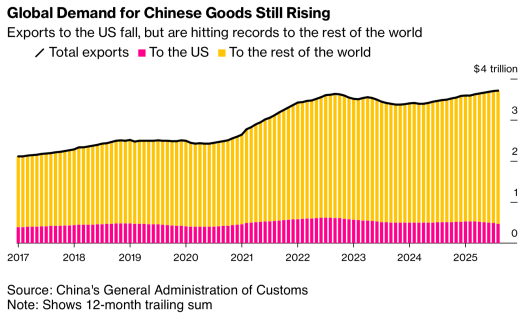
China’s trade surplus exceeded US$1 trillion for a second consecutive year, official data released on Tuesday showed, as exports surged 35.2% year‑on‑year in October and imports rose 41.6%.
Between January and October, China logged a US$1.04‑trillion trade surplus. The surplus narrowed in October to US$105.3 billion from US$133.5 billion in September as imports picked up, putting the country on track to surpass last year’s record US$1.2‑trillion surplus in 2026.
“We expect Chinese exports to stay strong for the rest of this year, led by electronics and autos,” said Dave Chia, an economist at Moody’s Analytics.
China trade surplus driven by export surge
Exports have expanded rapidly this year, supported by high‑tech goods such as semiconductors and autos. China’s semiconductor exports in October jumped 137.1% in value from a year earlier, while auto exports rose 37.6%.
China’s exports to the US grew 32.9% in October year‑on‑year, recovering from a low base after last year’s tariff increases. Exports to the EU rose 24.3% in October and 17.2% in January–October.
For the first ten months of the year, China’s trade surplus with the US was about US$266.5 billion; the ten‑month surplus with the EU was more than US$310 billion. In 2025 the EU recorded a roughly US$410‑billion trade deficit with China, or more than US$1.1 billion each day. Figures reported by China often differ from those reported by its trading partners.
Imports rebound and mounting risks
Imports climbed 41.6% in October, aided in part by a recovery in crude oil shipments from the Persian Gulf. Strong exports have helped offset sluggish domestic demand; the economy is forecast to meet Beijing’s official target of 4.5% to 5% growth this year, slightly below last year’s 5% expansion.
Analysts and industry representatives warned of mounting pressures. Alicia García‑Herrero, chief economist for Asia Pacific at Natixis, said overcapacity in many industries, excess domestic savings and weakened domestic demand are still pushing China to export goods abroad as some countries turn to protective measures. “The situation is not sustainable,” she said.
Manufacturers report fierce competition at home. “It comes down to product quality, or rather the increasing lack of it across the industry, since there’s significant homogenisation,” said Cinders Zhou, who sells eyewear for a manufacturer in Linhai city, Zhejiang province. “That has forced everyone to compete on price.”
Trade curbs by the European Union add another risk at a time of heightened US trade barriers and tariffs, Chia said, though Nguyen Hoang Nam of Capital Economics noted the EU measures apply to only a small part of China’s exports.
There are also sectoral downside risks tied to the technology cycle. “If the AI boom slows or turns into a correction, lower chip and electronics prices and smaller shipping volumes would hit China’s exports hard,” Chia said, a concern sharpened, the report said, by Democratic gains in the recent US mid‑term elections and a public backlash over data centres.
Trade tensions are likely to feature in planned meetings between US President Donald Trump and Chinese leader Xi Jinping next week on the sidelines of the Asia‑Pacific Economic Cooperation leaders summit in Shenzhen. A two‑month extension of a trade truce until January has offered some relief to exporters, though its durability is unclear.
US and European trade policies have created “a lot of difficulties” for Chinese businesses trying to expand abroad, said Wang Xin, head of the Shenzhen Cross‑Border E‑Commerce Association.
