

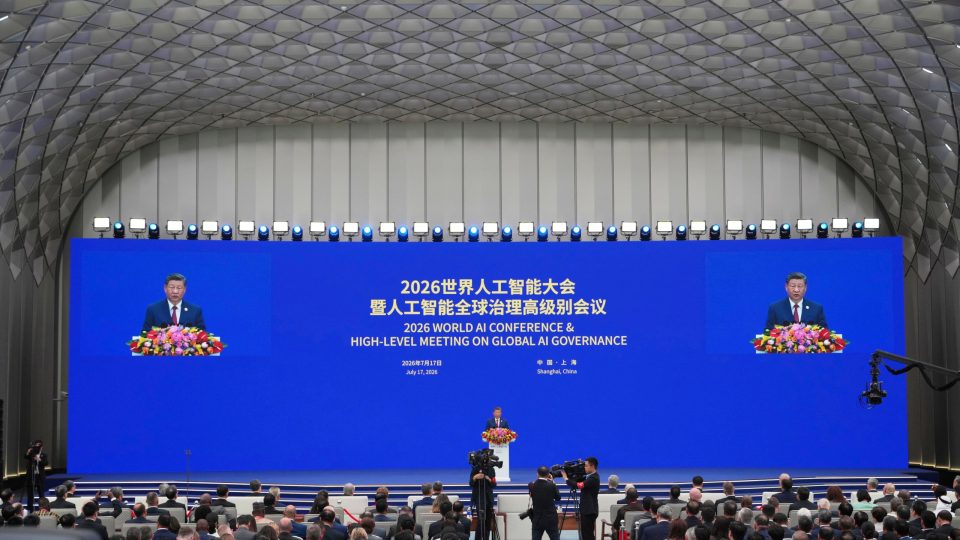
Chinese President Xi Jinping delivered a major address on the future of artificial intelligence (AI) on July 17 in Shanghai — his first in-person speech at the World AI Conference opening since 2018. The remarks came a day after 29 countries signed the agreement establishing the World Artificial Intelligence Cooperation Organization (WAICO), a new intergovernmental body based in Shanghai. Delivered to representatives from more than 100 countries and organizations, including the UN Secretary‑General, Xi’s speech advocated an open, multilateral, development‑oriented approach to AI.
A clear message against a “race” dynamic
Xi positioned his vision against what he characterized as an American “Winning the Race” strategy, promoting instead a model based on “open source, openness, collaboration and sharing.” He rejected the notion that AI should serve as an instrument of national supremacy, urging against elevating “the concept of national security in the field of AI” or sacrificing other countries’ security for the benefit of a single state. His metaphor — “one string does not make music, one tree does not make a forest” — was used to underline collective governance over exclusive competition.
WAICO: institutionalizing a multilateral alternative
The creation of WAICO, announced the day before the speech, embodies the institutional translation of that message: an international framework intended to involve Global South countries in shaping AI rules and standards. Founding members named include Cuba, Ethiopia, Kenya, Laos, Pakistan, Brazil, Indonesia and Venezuela. The presence of the UN Secretary‑General at the signing was highlighted as a symbolic marker of legitimacy.
Concrete commitments for the Global South
Xi paired his remarks with quantified pledges aimed at developing countries: 5,000 AI training opportunities over five years; the creation of international cooperation centers for AI applications with regional organizations (ASEAN, the Arab League, the African Union, CELAC, the SCO and BRICS); and making the MAZU predictive meteorological system available to 30 countries. These measures are presented as efforts to narrow digital divides and avoid “a new historical injustice” associated with the diffusion of AI.
A contrasted economic and social model
The speech drew a contrast between two paradigms: on one side, a model dominated by large corporations and driven by profit and national security logics; on the other, what Xi described as a “socialist market economy” oriented toward social benefits — jobs, healthcare services, industrial applications — and preserving human control over systems. He cited domestic examples such as medical screening tools and integrated industrial programs, without providing additional data beyond official announcements.
Governance, norms and standards: the case for “true multilateralism”
Xi reiterated the importance of a framework governed by international consultation and underscored the central role of the United Nations in developing technical, ethical and regulatory standards. He framed the initiative as part of a series of global proposals Beijing has advanced in recent years to promote cooperation, development, security and civilization exchanges around emerging technologies.
Xi’s address and the launch of WAICO sketch a clear diplomatic and institutional alternative to Washington’s approach. By proposing concrete tools for training and regional cooperation, Beijing is betting on the diffusion and accessibility of AI as levers of foreign policy and global governance. Ultimately, implementation will determine whether these initiatives reshape global AI governance.
