

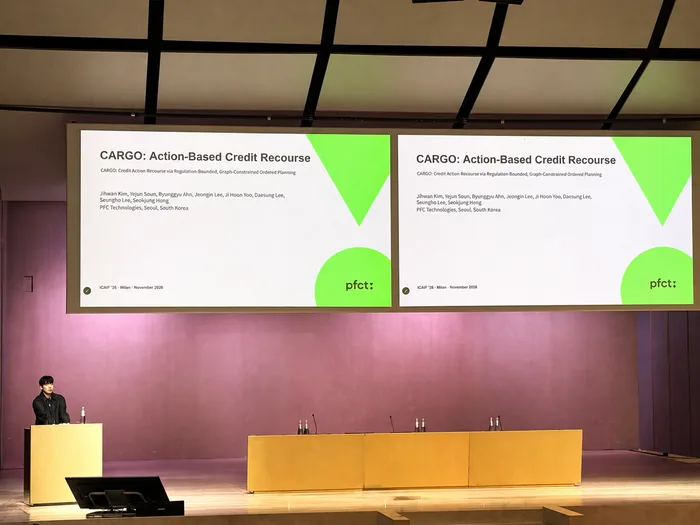
PFCT (PFC Technologies) and Kakao Bank announced on the 18th that each had two papers accepted at the International Conference on AI in Finance (ICAIF) 2026, held in Milan, Italy from April 14 to 17. ICAIF, organized by the Association for Computing Machinery (ACM), marked its seventh anniversary this year.
PFCT advances credit guidance beyond XAI
PFCT had two papers accepted, one of which was selected for an oral presentation and ranked among the top 5% of all submissions. The first study moves beyond Explainable AI (XAI) by not only explaining reasons for loan rejection but also suggesting actionable steps to increase the likelihood of approval. PFCT reorganized credit rating information into action units—such as loan repayment and delinquency resolution—and modelled how a single action affects multiple credit attributes together. The paper gives, for example, that repayment of a loan would reflect a decrease in the number of loans and outstanding balances, while excluding measures that are difficult for an individual to implement.
The second PFCT paper addresses predicting credit risk under changing economic conditions. The method actively leverages predictive models trained on past periods similar to the present economic situation; experiments using mortgage and personal credit loan data showed predictive performance higher than existing methodologies. PFCT said its R&D begins with real-world financial problems rather than theory, and CEO Lee Soo-hwan commented: “It is PFCT’s competitiveness to develop this awareness of the problem into its own AI technology and connect it to commercialization through AirPACK.”
Kakao Bank models customer conversations and macro trends
Kakao Bank’s Financial Technology Research Institute presented two studies: one on AI that understands customer finance conversations and another on predicting broader financial situations. The first paper proposed a methodology to virtually construct financial conversations that follow a client’s life cycle and to evaluate how accurately an AI captures a client’s long-term financial history and current situation across multiple time points.
The second paper proposed a method for predicting macroeconomic trends by analysing recurring financial events—such as corporate earnings announcements and base-rate decisions—and applying reasoning from similar past cases to new events. The paper argued this approach could enable more detailed predictions of major macroeconomic variables, including market conditions and monetary policy.
During the conference, Kakao Bank also hosted workshops on security, safety, and personal information protection with global financial and technology institutions. An official from Kakao Bank said, “The competitiveness of financial AI depends on how accurately it can understand and predict the financial environment and the context of customers.”
