

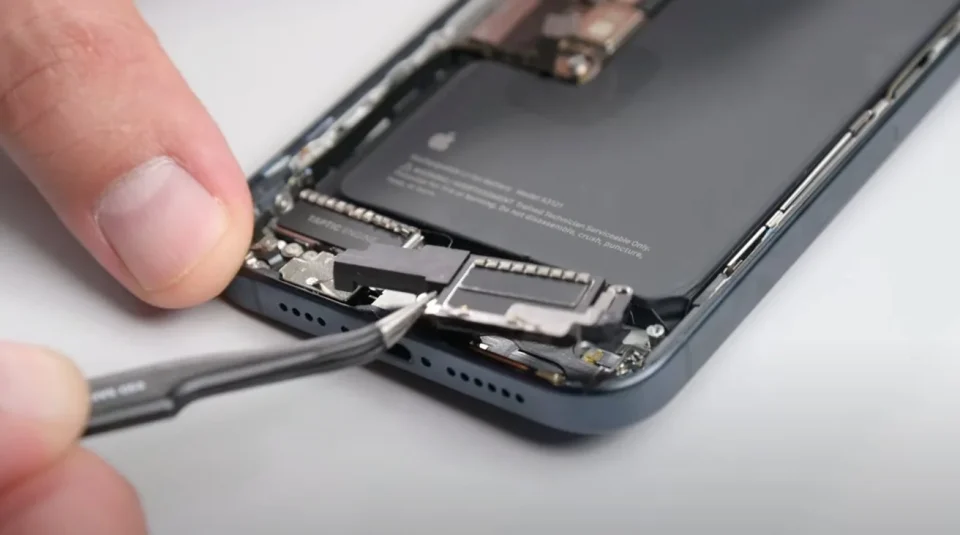
A teardown of Apple’s HomeView found the device is more difficult to repair than the HomePod, with attempts to open it resulting in damage to internal components.
Getting into the unit required prying through strong adhesive that secures the display; that adhesive was difficult to remove. Inside, a mix of Phillips and Torx screws in various sizes secures internal parts, necessitating several different tools.
Why HomeView is hard to repair
Speakers occupy most of the internal space directly behind the display, with the logic board located behind them. The logic board is covered by a shield that connects to the back of the aluminum enclosure, effectively turning the enclosure into a heat sink to improve thermal performance. Thermal paste and adhesive attaching the shield to the casing made the logic board difficult to remove.
The speakers are held in place with a thick adhesive pad; attempting to remove one caused it to snap in half. Multiple cables link the display to the speaker base, and the teardown found the wall-mounted and tabletop HomeView models are not interchangeable: the wall-mounted version uses a larger logic board, while the tabletop model adopts larger speakers and a pivot mount.
The HomeView speaker base is designed similarly to a HomePod and was easier to disassemble. The USB-C port on the base is modular and can be replaced, as can the two passive speakers inside the enclosure. Because of the device’s assembly, it is not possible to separate the display from the base without going through the display side.
The teardown concluded that Apple made several design choices that ‘made repairs unreasonably and unnecessarily difficult’ and showed little thought for repair options.
