

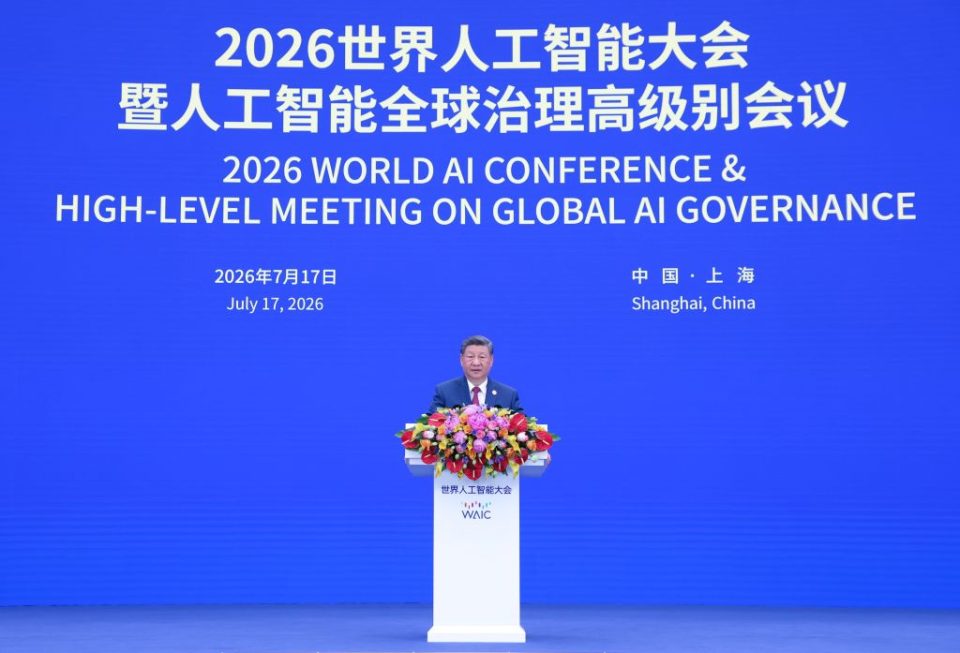
Chinese President Xi Jinping on Friday called for AI governance and development to be treated as a global effort, warning against what he described as an “over-extension” of national security concerns. In his keynote at the World Artificial Intelligence Conference in Shanghai, Xi put international cooperation at the center of Beijing’s response to rising technological tensions.
A call for global AI governance
Xi argued that “the development of artificial intelligence should not be a solo performance by one country, but a symphony of global cooperation,” and he warned that national-security arguments should not be used to restrict access to technology. He reiterated Beijing’s stance that U.S. restrictions limiting Chinese access to certain advanced technologies are feeding rivalry between the two largest economies.
A new global organization and expanded partnerships
At the summit, 29 countries — including Pakistan, Russia and Kazakhstan — signed an agreement to create a World Artificial Intelligence Cooperation Organization, an intergovernmental body based in Shanghai intended to promote international AI governance. Xi also announced broader cooperation with regional blocs and developing countries — ASEAN, the Arab League, the African Union, CELAC, the Shanghai Cooperation Organization and BRICS. Beijing said it will offer an AI weather tool to 30 countries and provide 5,000 AI training slots to developing nations over the next five years.
Tech rivalry and Sino‑U.S. dialogue
China’s initiative can be read as a response to the U.S.-led “Pax Silica,” which focuses on securing AI supply chains with allied partners. Following a visit by the U.S. president to Beijing in May, the two capitals agreed to open a dialogue on AI development and governance — a commitment referenced during the conference.
Breakthroughs in Chinese models and market reactions
The event was notable for Moonshot’s unveiling of Kimi K3, a new Chinese large model that surprised parts of the U.S. industry with its performance. Independent rankings cited at the conference placed K3 at the top on certain front-end coding benchmarks, with performance comparable to leading releases from Anthropic and OpenAI. Observers called the launch a possible turning point for Chinese open-source models, though some dismissed reactions as overblown. Zhipu’s recently released GLM-5.2 (Z.ai) is already seeing broad developer adoption. While K3’s usage price is the highest yet for a Chinese model, a Bank of America report said it remains roughly half the cost of OpenAI’s GPT-5.6 Sol.
Hardware, ecosystem and international presence
The conference also showcased domestic hardware advances: Huawei presented the Atlas 950 SuperPoD compute system, highlighting China’s progress toward a domestic hardware stack despite U.S. component restrictions. More than 1,100 companies and 1,400 guests attended, including leaders from Kazakhstan, Cambodia and Thailand, as well as the U.N. secretary-general.
A dual strategy: Global partner and technological self‑reliance
Beijing’s approach reflects a two-pronged strategy: positioning itself as a partner for the global South while accelerating domestic tech autonomy. The conference signaled a determined push to shape global AI governance even as China pushes to reduce dependence on Western technology.
