

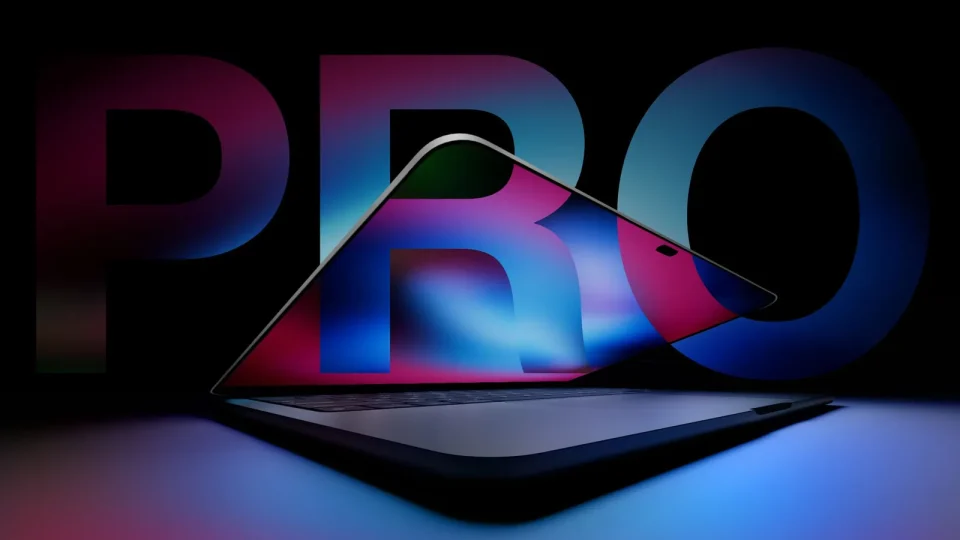
Apple is preparing a high-end OLED MacBook Pro that is reportedly nearly ready to launch, marking the first Mac with both an OLED display and a touchscreen.
Design and size options
Apple has not significantly redesigned the MacBook Pro since the M1 Pro and M1 Max models in 2021, and the new machine is expected to introduce modest design tweaks. Rumors indicate the laptop will be lighter and possibly a bit thinner, with Apple replacing the notch with an iPhone-style Dynamic Island. The Dynamic Island could also help unify Siri behavior across iPhone and Mac with iOS 27 and macOS Golden Gate. No widespread changes to the keyboard or trackpad have been reported. The OLED MacBook Pro is expected in both 14-inch and 16-inch sizes; it is not yet clear whether it will replace current models or sit above them as a higher-end option.
OLED MacBook Pro display
This MacBook Pro will be the first to use OLED at Apple’s laptop scale. OLED is expected to offer richer colors, higher contrast and true blacks compared with current mini-LED panels, with less blooming because individual pixels can turn off. Reports say Apple is using rigid OLED panels with oxide TFT backplanes and advanced tandem OLED structures—the same tandem approach used in the iPad Pro—which should provide a longer lifespan and reduced burn-in compared with single-stack OLED. OLED often delivers better HDR but can fall short of mini-LED on peak brightness in some cases.
Touchscreen and macOS adaptations
Alongside OLED, the new MacBook Pro is expected to include the first touchscreen on a Mac. Touch input will be designed to complement the keyboard and trackpad rather than replace them, with users able to interact with the display using their fingers similar to an iPad. Apple plans a reinforced hinge to reduce wobble when the screen is tapped. Several features in macOS Golden Gate hint at touch-friendly design: Sidecar now supports direct touch input when using an iPad as a Mac display, and macOS Golden Gate includes an iPhone-style pull-to-refresh option usable across apps such as Safari, Mail, News, Podcasts and Calendar—behaviors that make sense on a touch display.
Chips, naming and roadmap
The OLED MacBook Pro is expected to ship with the current high-end M5 Pro and M5 Max chips. Apple introduced an M6 chip in the latest Mac mini and is expected to use M6 in a lower-end MacBook Pro and an iMac announced on October 28, but Bloomberg reporting indicates no M6 Pro or M6 Max is planned. Apple has accelerated work on the M7 series—whose chips are said to feature major neural-processing improvements—and a second-generation OLED MacBook Pro is planned to use M7 Pro and M7 Max chips in late 2027. Earlier rumors that the new model would be called “MacBook Ultra” appear not to be happening; Apple is keeping the Pro name, reflected in the launch tagline “Pro and tell.”
Pricing and launch timing
The OLED MacBook Pro is expected to be a premium product with a price above current MacBook Pro models. Apple raised Mac prices in June 2026, increasing MacBook Pro prices by a minimum of $300. After those hikes, the higher-end 14-inch MacBook Pro with M5 Pro starts at $2,499 and the 16-inch M5 Pro starts at $2,999. M5 Max models start at $4,099 for the 14-inch and $4,399 for the 16-inch. Apple will introduce new Macs on Wednesday, October 28 as part of a “Pro and tell” launch; there will be no livestreamed event, though some press have been invited to Los Angeles to try the devices. The OLED MacBook Pro could launch as soon as November 6.
