

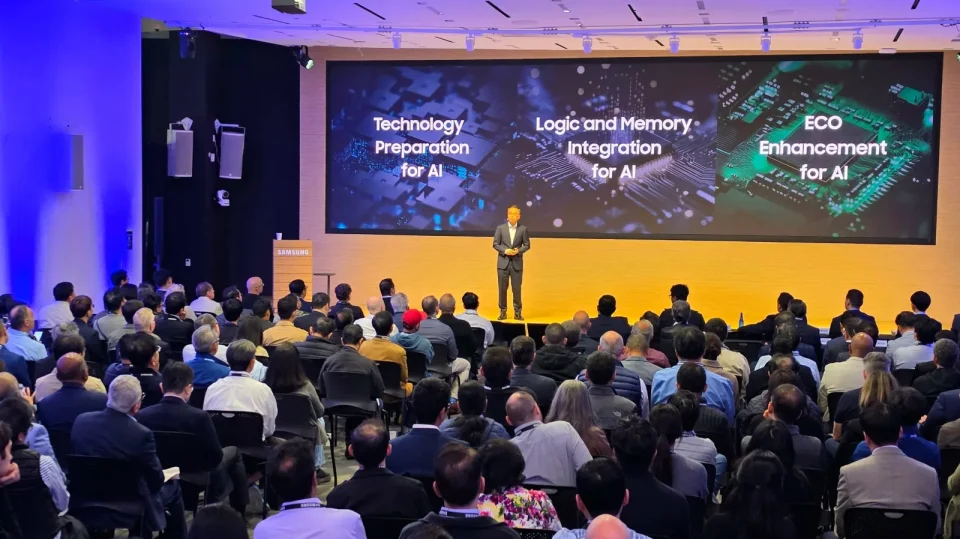
Samsung Electronics’ DS Division said on the 13th that it had held the “Semiconductor Tech Seminar” on the 10th at the Win-Win Cooperation Academy in Suwon, Gyeonggi Province, sharing AI semiconductor technology with about 1,000 employees of partner companies who participated online and in person. The event was presented as part of the division’s effort to share the latest semiconductor technology trends and strengthen its technological competitiveness.
Held regularly twice a year since 2019, the seminar this half focused on rising demand for AI semiconductors and featured the themes “The Evolution and Future of Memory Semiconductor Technology in the AI Era” and “A Paradigm Shift in Materials Technology Amid Changes in Semiconductor Technology.”
AI semiconductors and the memory roadmap
Hwang Cheol-Seong, a specially appointed chair professor at Seoul National University, outlined structural changes in the global semiconductor industry and presented a roadmap for memory technology. He explained development directions for next-generation device technologies to overcome limits of high-density integration in DRAM and NAND flash, and addressed high-bandwidth memory (HBM) stacking and packaging technologies.
Kim Yun-ho, head of Samsung Electronics’ Foundry Materials Technology Team, reviewed materials technology challenges and development directions for various semiconductor products. He stressed the importance of partner collaboration, saying, “Materials are one of the pillars of core technologies for future semiconductors, alongside circuits, processes and equipment.”
Ji Hyeon-gi, head of Samsung Electronics’ DS Division Win-Win Cooperation Center and a vice president, emphasized the role of semiconductors in AI, stating, “The semiconductor industry is a key driver of AI innovation, and without advances in semiconductors, AI development is impossible.” He added, “We will continue to carry out various activities to strengthen our partners’ technological capabilities.”
