

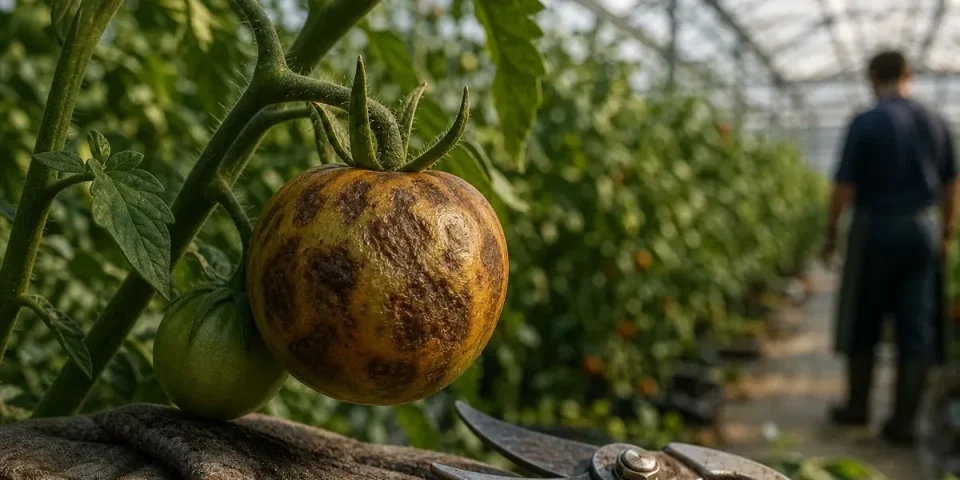
Tomato brown rugose fruit virus (ToBRFV), a virus subject to national quarantine controls, was recently detected at a greenhouse farm in Busan, prompting calls for farmers to tighten biosecurity, including restricting outside access.
On the 8th, the Busan Agricultural Technology Center said ToBRFV is a highly pathogenic virus that affects solanaceous crops such as tomatoes, bell peppers and chili peppers.
ToBRFV transmission, symptoms and impact
Infected plants develop mosaic mottling on leaves, wrinkles and deformities that can make leaves as thin as needles. Stem and calyx necrosis can result in poor fruit set or fruit drop; in severe cases fruit rots and production can fall by 30 to 70 percent, inflicting heavy damage to farm incomes.
There is currently no control agent available. The center warned that the virus can spread inside greenhouses through even slight contact — from workers’ hands, gloves and pruning shears, and also via shoes or brushing against work clothes — and can remain infectious for long periods when present on seed coats or plant debris.
The city’s Agricultural Technology Center urged farmers to strictly follow key biosecurity measures to prevent infection, specifically by barring outsiders from entering, preventing contact transmission at the source and reporting suspected cases remotely. For advice about symptoms or to request testing, farmers were told to call the center’s Technical Agriculture Team.
Park Mi-jin, director of the Busan Agricultural Technology Center, said: “It is of utmost importance to understand the virus’s characteristics and for farms to prevent its introduction themselves by restricting outside access and maintaining rigorous hygiene.”
Around 520 farms currently grow tomatoes in Busan’s Gangseo area.
