

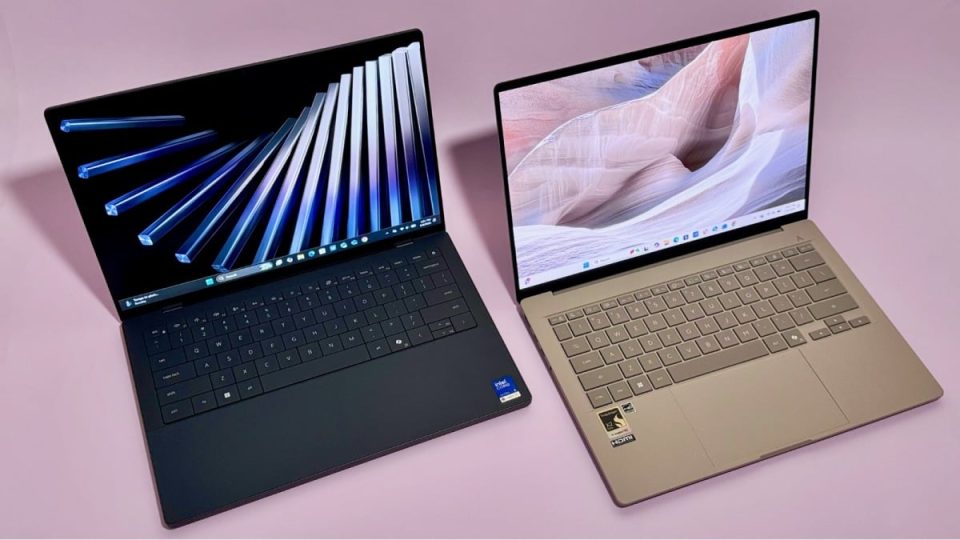
The Dell XPS 14 for 2026 is a sleek option for those who prioritize aesthetics and power, appealing particularly to content creators and occasional gamers. It serves as a compelling alternative for those seeking a more portable version of the 14-inch MacBook Pro, especially if you’re eagerly awaiting Apple’s anticipated touchscreen OLED upgrade. While the price can reach nearly $3,000 without a dedicated GPU, Dell frequently offers sales on its website.
The XPS 14, equipped with the Intel Core Ultra X7 358H processor, competes closely with Apple’s M5 chip in multi-core tasks, though it lags slightly in single-core performance. Its Intel Arc B390 integrated GPU is comparable to an entry-level dedicated graphics card, capable of handling demanding games like Cyberpunk 2077 with Intel’s AI upscaling technology.
Despite its impressive performance, the XPS 14’s battery life is a weak point, lasting only 10 hours and 19 minutes in video tests compared to the MacBook Pro’s 21-hour endurance. However, the display’s ability to reduce its refresh rate to 20Hz for static content could extend battery life in less demanding scenarios.
For better battery performance, the base model with an Intel Core Ultra 5 325 chip offers 22 hours of video playback, though it sacrifices power and display quality. This model’s performance is similar to the M2 MacBook Air from 2022, with a less vibrant LCD screen.
Design-wise, the XPS 14 is one of the most stylish laptops available, featuring a refined all-aluminum body that’s thinner and lighter than its MacBook counterpart. It comes in two finishes, graphite and shimmer, and includes a modern lattice keyboard and a clean glass haptic touchpad. Its speakers are decent for a Windows laptop, though not quite on par with a MacBook’s. The OLED display offers vibrant colors and smooth visuals at 120Hz, although it doesn’t match the brightness and crispness of the MacBook Pro’s Liquid Retina XDR display.
The review unit, priced at $2,879.99, is costly, especially compared to an M5 MacBook Pro with similar RAM and storage, which costs almost $800 less. While the MacBook lacks an OLED display, it offers superior battery life, better single-core performance, and more ports, making it a better overall value.
