

World AI Conference 2026 spotlights AI innovations that could reshape healthcare — from diagnosis to drug management
Shanghai — The World AI Conference 2026 put a spotlight on a wave of artificial intelligence innovations aimed at transforming healthcare, presenting advances that span rapid diagnosis, personalized medication guidance and everyday health monitoring.
A large-scale showcase
The four-day event in Shanghai brought together government representatives, corporate leaders, researchers and academics from more than 100 countries and international organizations. The program included 140 forum sessions and an exhibition floor exceeding 100,000 m², where over 1,100 companies displayed some 3,000 products.
A TCM robot that mimics experienced practitioners
One crowd-pleasing exhibit was a robot for traditional Chinese medicine (TCM) that completes a diagnostic assessment in three to five minutes and produces a complementary report using a large language model trained on clinical data. “In collaboration with more than 300 hospitals, we collected over 200,000 TCM clinical cases, and more than 500 senior practitioners annotated the data. After more than two years of data cleaning and model training, the robot’s capability is comparable to a TCM practitioner with ten years of clinical experience,” said Bai Weimin, president of Andun Health.
Wearables and AI glasses for daily monitoring
Exhibitors also showcased wearables designed for continuous health monitoring. Among them, AI-powered glasses equipped with a motion-detection module track head posture and trigger alerts related to cervical spine health. “If the device detects prolonged downward gazing, a cervical-spine alert will be issued. In the future we’ll integrate this with large health models to deliver personalized recommendations based on users’ underlying data,” said Peng Wenjia, product lead for the Qwen AI glasses.
Medical AI agents to personalize drug use
The conference highlighted solutions that move beyond monitoring: vertical medical agents can predict adverse drug reactions from a patient profile and provide tailored guidance on treatment regimens. “In the future, patients won’t just receive a box of pills — they’ll receive an AI agent. For example, lung cancer patients may not know what an ALK mutation is, even though it determines the entire treatment pathway. We’ve built a dedicated AI agent for each specific drug that can answer any question about that medicine,” said Zhang Xiaodong, CEO of MediTrust Health.
Trends and scope
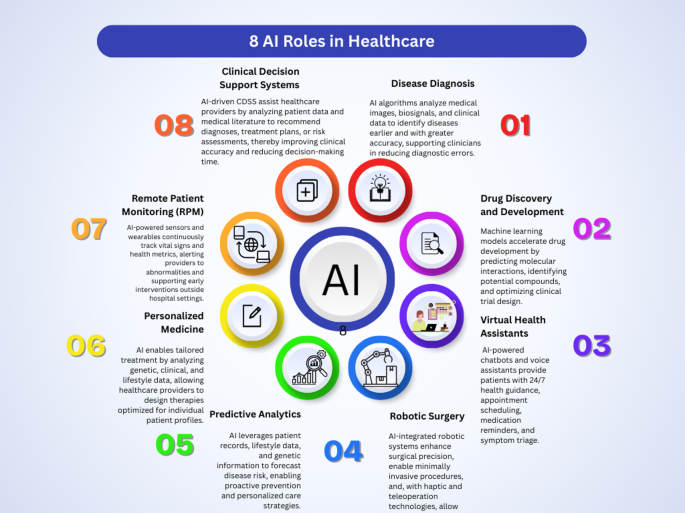
Demonstrations at the World AI Conference 2026 underscored a clear push to integrate AI across prevention and therapeutic management. The exhibited cases ranged from clinical expertise simulation and personalization of medication pathways to real-time patient-facing monitoring tools that alert and inform.
While these innovations — showcased on an international stage — highlight how rapidly AI is positioning itself as a complement to existing medical practices, they do not constitute independent clinical evaluations of effectiveness or proof of readiness for widescale operational deployment.
