

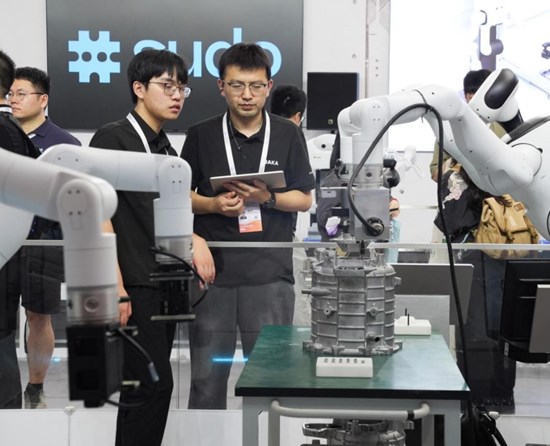
The World AI Conference & High‑Level Meeting on Global AI Governance took place in Shanghai from July 17 to 20, 2026. Chinese President Xi Jinping attended the opening ceremony and delivered the keynote under the theme ‘AI Partnership for a Brighter Future,’ framing China’s ambition to move beyond being merely an application market and to help shape global rules for AI development.
China’s AI growth and technological positioning
By data released at the conference, the value of China’s core AI industry exceeded RMB 1.2 trillion in 2025, with more than 6,200 specialized AI companies that grew to over 6,600 by 2026, representing 15 percent of the global total. Delegates and observers noted China’s combined advances in innovation and cost control: Chinese AI start-ups are reported to offer high cost‑performance systems and China has established a strong presence in open source. According to figures cited at the event, most of the world’s leading high‑performance open‑source AI models originate in China and cumulative global downloads of open‑source large models have exceeded 10 billion. International technology companies have incorporated Chinese models into their stacks.
World AI Conference outcome: WAICO and governance proposals
In his keynote, President Xi outlined four proposals for global AI governance: ‘upholding openness and win‑win cooperation,’ ‘strengthening risk awareness,’ ‘encouraging inclusiveness’ and ‘promoting solidarity and collaboration.’ The conference’s most significant institutional outcome was the establishment of the World Artificial Intelligence Cooperation Organization (WAICO). On July 16, representatives from 29 countries signed the agreement to create WAICO at the Shanghai World Reception Hall, an event witnessed by UN Secretary‑General António Guterres. Organizers and some regional officials said WAICO aims to provide a standing mechanism to balance development and security while promoting openness, inclusiveness and broad accessibility.
Cooperation measures and regional responses
China announced practical measures to support inclusive AI as a global public good: 5,000 places in specialized AI training programs for developing countries over the next five years; the establishment of international AI application cooperation centers for regional organizations including ASEAN, the African Union and BRICS; and promotion of the ‘Mazu’ AI‑powered meteorological early‑warning solution in 30 countries. TICON Africa said WAICO could open new channels for cultivating AI talent and building digital infrastructure across the continent, while Southeast Asian officials highlighted hopes that the platform will advance multilingual intelligent technologies and smart agriculture. The conference also featured the release of an Action Plan for AI Cooperation and Development and the launch of frontier models such as Kimi K3.
Persistent challenges: infrastructure, dependence and geopolitics
Speakers and reports at the conference emphasized that declarations alone cannot close the digital divide. Citing the Microsoft 2025 AI Diffusion Report, generative AI adoption in the second half of 2025 stood at about 24.7 percent in Global North countries versus roughly 14.1 percent in the Global South. Many developing countries face constraints in electricity, internet connectivity and digital skills, creating an infrastructure gap that limits reliable operation even of lightweight models. Delegates also warned of a new form of technological dependence: while open‑source models reduce commercial monopolies, developing countries risk remaining dependent if they do not build foundational algorithms and high‑quality local‑language data. Finally, the conference highlighted geopolitical friction: differing development philosophies and security priorities can raise the costs of cooperation and fuel a tug‑of‑war between open sharing and defensive barriers.
The World AI Conference showcased China’s accelerating role in AI development and its push to shape global governance and provide public goods. Yet organizers and participants acknowledged that turning those ambitions into widespread, sustainable capacity across the Global South will require confronting infrastructure shortfalls, risks of dependence and geopolitical contestation.
