

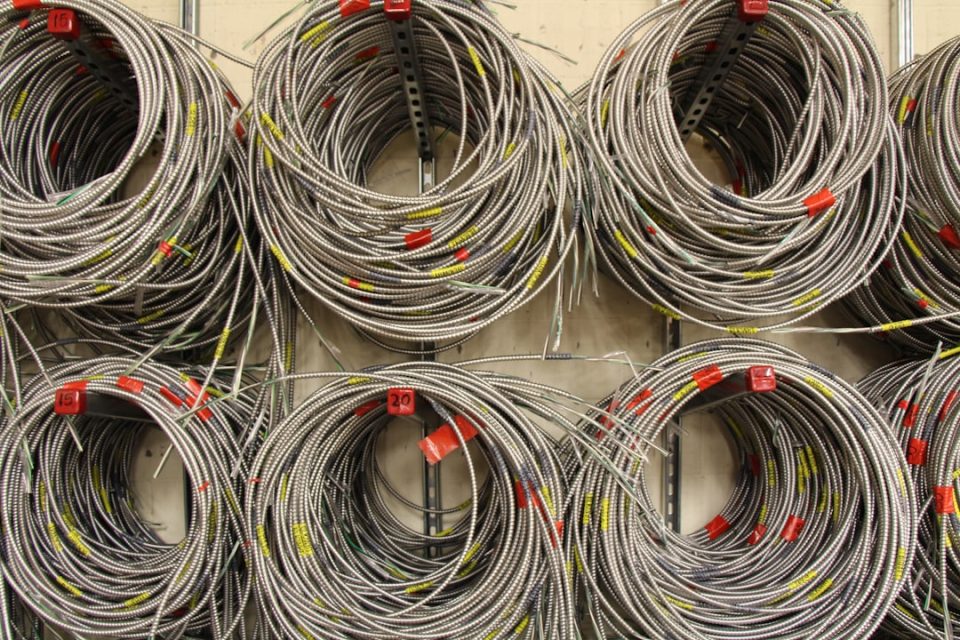
The global data center industry is undergoing a transformation driven by cloud computing, artificial intelligence, hyperscale data centers, and edge computing. At the heart of modern data centers is a sophisticated cabling infrastructure essential for high-speed, reliable, and secure data transmission. Data center cables have evolved into strategic assets impacting network performance, scalability, energy efficiency, and resilience.
As enterprises increasingly migrate to the cloud and adopt AI-driven applications, the demand for high-bandwidth, low-latency connectivity is surging. Hyperscale data centers, operated by major cloud providers, require advanced fiber optic and high-performance copper cabling to support data transfer speeds up to 1.6T Ethernet. This shift presents significant opportunities for cable manufacturers offering innovative, high-density solutions.
Edge computing is also expanding, necessitating investments in compact, modular data centers closer to users. These centers demand reliable cabling systems for applications like autonomous vehicles, industrial automation, healthcare, financial services, and smart cities. The proliferation of IoT devices is generating vast data volumes, further challenging network infrastructure.
Fiber optic technology is favored for long-distance, high-speed communication due to its superior bandwidth, lower latency, and resistance to electromagnetic interference. Copper cabling remains vital for short-distance connections within racks and server cabinets due to its cost-effectiveness and compatibility.
Leading manufacturers, including Corning, Amphenol, Nexans, TE Connectivity, Prysmian Group, Furukawa Electric, Sumitomo Electric, Panduit, Belden, and LAPP, are investing in advanced cable technologies to meet modern digital infrastructure demands.
The global data center cable market is rapidly growing, fueled by internet penetration, cloud adoption, enterprise digitalization, and hyperscale data center expansion. Modern data centers require extensive cabling systems for servers, storage devices, networking switches, routers, and external networks. These cables must provide high bandwidth, low latency, and reliability to support AI, machine learning, cloud computing, streaming services, and enterprise applications.
Organizations are future-proofing infrastructure with structured cabling systems for easier upgrades and reduced long-term costs. The adoption of modular cabling architectures, pre-terminated fiber systems, and high-density patch panels is increasing.
The shift to software-defined networking, virtualization, and cloud-native applications is driving demand for advanced cabling solutions supporting ultra-high-speed Ethernet standards.
Several factors are accelerating the global data center cable market growth. Cloud computing expansion remains a strong driver, with public cloud providers expanding infrastructure to meet growing demand for IaaS, PaaS, and SaaS. The rise of AI and high-performance computing is increasing demand for ultra-fast communication between GPUs, CPUs, storage systems, and networking equipment. Hyperscale data centers require high-density fiber cabling, low-loss optical connectors, intelligent cable management, scalable structured cabling, and high-speed backbone connectivity.
Edge computing is deploying data centers closer to users to minimize latency for applications like autonomous vehicles, smart manufacturing, healthcare, financial trading, smart cities, retail analytics, and industrial IoT. Rising internet traffic from video streaming, online gaming, remote work, and digital commerce boosts demand for advanced data center cables.
Fiber optic cables dominate high-speed backbone connections due to their bandwidth, long transmission distances, minimal signal loss, electromagnetic interference immunity, scalability, and energy efficiency. Copper cables remain important for shorter network connections due to lower installation costs, compatibility with existing infrastructure, easy deployment, PoE capability, and reliable short-distance communication.
Emerging technology trends include high-density fiber connectivity, 800G and 1.6T Ethernet, AI-optimized networks, and intelligent cable management. Regional market analysis shows strong growth in North America, Europe, Asia-Pacific, the Middle East & Africa, and Latin America.
The competitive landscape is dynamic, with manufacturers focusing on innovation, product quality, sustainability, and strategic partnerships. Companies are investing in research and development for next-generation Ethernet standards, hyperscale data centers, AI networking, and cloud infrastructure.
Despite growth prospects, the market faces challenges like rising raw material costs, supply chain disruptions, rapid technology evolution, high infrastructure investment, sustainability requirements, and skilled workforce shortages.
The future of the data center cable market is linked to AI, cloud computing, edge computing, and high-performance networking evolution. Fiber optic technology is expected to dominate due to scalability, low latency, and support for emerging standards. AI infrastructure presents long-term growth opportunities, with AI clusters requiring dense, high-speed optical interconnects. Sustainability will be a competitive factor, with customers prioritizing manufacturers offering recyclable materials and energy-efficient processes.
Overall, the global data center cable market is poised for sustained growth as digital transformation, AI adoption, hyperscale expansion, and cloud computing reshape the technology landscape.
