

New York-based Pythag Tech has closed a $4.25 million seed round led by climate-focused early-stage investor Azolla Ventures. The company said it will use the capital to expand its biological dataset and the machine-learning platform that designs cultivated meat production processes for licensing to food companies.
Pythag does not produce meat. Its business model is selling optimized production processes to large corporations that want to bring cultivated meat into commercial-scale production at a profit.
Pythag Tech’s AI targets three cost drivers
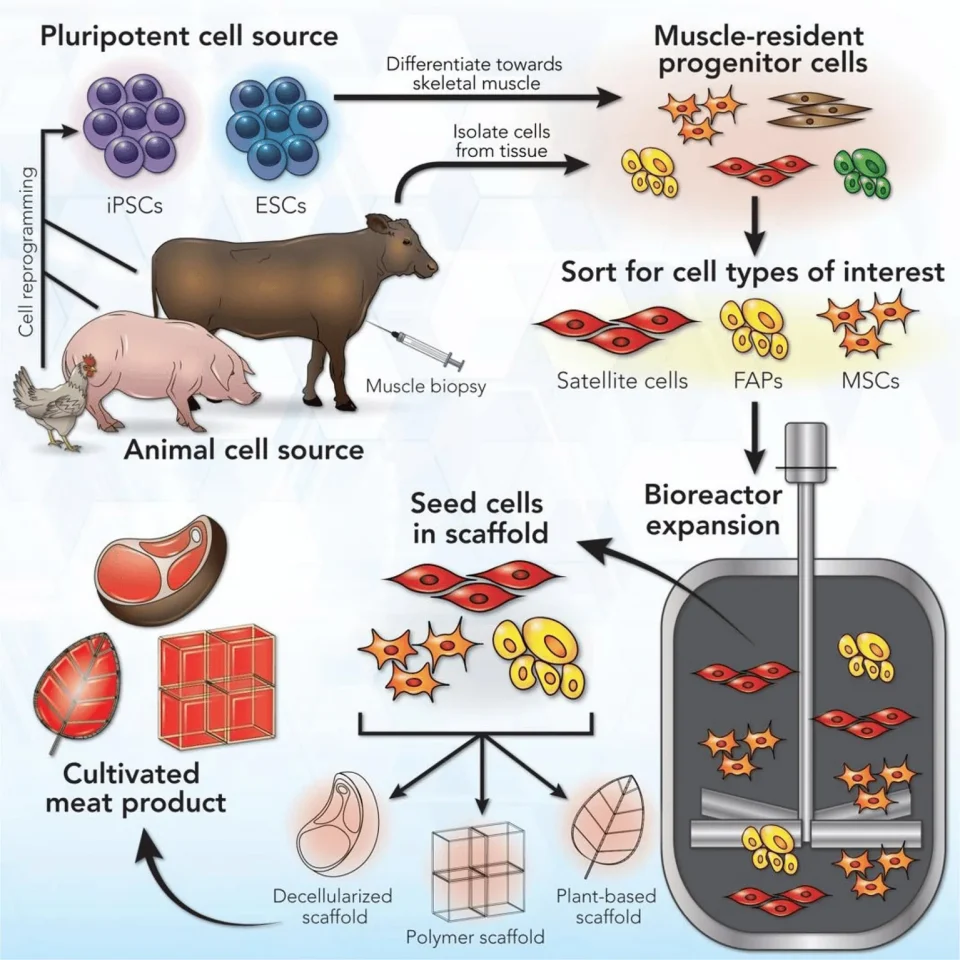
Pythag’s AI models direct large-scale laboratory experiments on growth media, cell line development and bioprocessing, which the company identifies as the three main cost drivers in cultivated meat production. Each experiment feeds a proprietary dataset; the models then use the expanded data to identify new production parameters for subsequent rounds of testing.
“The next generation of cultivated meat will be defined by how efficiently we can turn scientific experimentation into better production models. The fundamental case for cultivated meat has never been stronger, but there’s work to be done to make R&D more cost-effective and scalable. We’re building Pythag to solve this problem, and we’re grateful to have the support of incredible investors who believe in the long-term potential of the category,” said Sami Nabulsi, CEO of Pythag Tech.
From market data to production partnerships
Pythag first appeared in the sector in 2024 with the Clean Meat Terminal, a market intelligence platform for the cellular agriculture industry. In August 2025, Australian cultivated lamb producer Magic Valley partnered with Pythag to integrate its platform into production, with the companies citing lower per-kilogram costs and shorter R&D timelines as the expected outcomes.
Pitching cultivated meat to conventional buyers
The company frames its investment case partly around strain on conventional beef supply: a US cattle herd at its lowest level since the 1950s, screwworm outbreaks that have limited meat imports, and record ground beef prices. Pythag presents cultivated meat as a way for food companies to diversify supply chains and revenue streams.
“As societies become wealthier, they eat more meat: Global production per capita rose 55% from 1970 to 2020. Conventional methods struggle to keep up. Cultivated meat can provide a solution, but only if it provides functional equivalence at lower cost. Pythag is using AI to make cultivated meat production more efficient and scalable, helping deliver the future of food,” said Matthew Nordan, Co-Founder and General Partner of Azolla Ventures.
